Building resilient local health systems through embedded learning sites in Nepal
Context and issues
Nepal’s transition to a federal system has fundamentally reshaped how health services are governed, planned, and delivered. While decentralization has expanded decision space for local governments, it has also exposed persistent challenges, including unclear roles across tiers, limited coordination mechanisms, weak use of evidence, and fragile community health systems, particularly in resource constrained and politically complex settings.
Kapilvastu district in Lumbini Province reflects these challenges. Characterized by poor health indicators, low service utilization, recurring disease outbreaks, and limited institutional capacity, municipalities in Kapilvastu were selected as learning sites for the ReBUILD for Resilience programme, implemented by HERD International in Nepal.
Learning Site 1 was initiated in 2021 to strengthen local health system resilience. Building on the lessons generated, the concept of Learning Site 2 was introduced in 2024 to enable cross-municipality learning across the district and to implement focused interventions in a second municipality. An embedded approach was implemented in both sites, placing researchers alongside local health system actors to jointly diagnose problems, co-design solutions, and support iterative learning over time. This case study synthesizes learning from four consecutive years of engagement across the two learning sites.
The ‘learning site’ approach
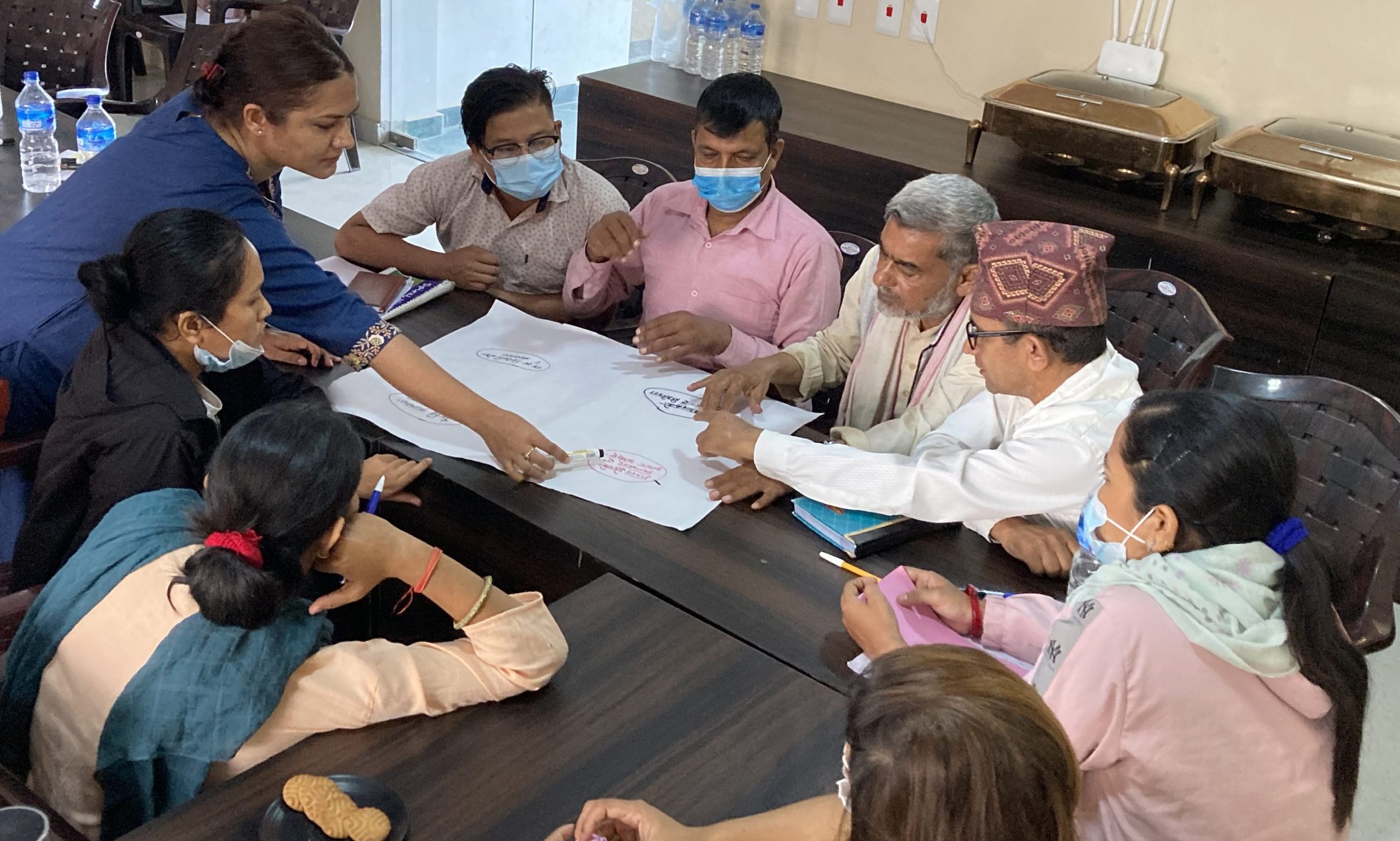
HERD International adopted a participatory action research approach, characterized by:
- A long-term embedded research team presence within municipal health systems.
- Joint problem identification and solution design with elected leaders, municipal officials, health workers, and community members.
- Iterative cycles of reflection, adaptation, and action.
- Alignment with government structures, planning cycles, and mandates.
In the beginning, issues identified through a resilience capacity assessment pinpointed specific leverage points for change. This evidence base informed a co-creation process (Regmi et al, 2026 – under review) with municipal stakeholders, resulting in an action plan and a Theory of Change to structure and evaluate what worked, and what did not. Rather than introducing new functions and implementing parallel interventions, the learning sites sought to strengthen health systems to effectively perform existing functions. Each learning site is grounded in the principles of establishing trust, building capacity, and institutionalizing lessons, promoting adaptive and transformative health system changes.
Strengthening foundations in Learning Site 1: Changes achieved
Re-establishing the governance platforms
Despite formal mandates, key governance structures such as the Municipal Health Management Committee and Health Facility Operation Management Committees (HFOMCs) were either inactive or non-functional in Learning Site 1. Monitoring and supervision were irregular and focused on programmatic reviews.
In response, the Learning Site prioritized:
- Reformation and revitalization of HFOMCs, including their establishment in newly-created Basic Health Service Centers and orientation of members on their roles.
- Development of policies and procedures, including municipal health policy, annual monitoring and supervision plan and checklist, and rapid response team guidelines. This shifted the basis of the decision-making process in day-to-day operations.
- Operationalization of the Minimum Service Standard (MSS), which is an assessment of all seven health-post-level health facilities, and identified gaps which were gradually addressed through the municipality and ward budgets.
- Strengthening roles of female community health volunteers (FCHVs) and revival of Health Mothers’ Groups, supported by ward and municipality level budget allocations.
These changes did not introduce new structures but reactivated existing ones, strengthening structure, accountability, inclusion, and local problem-solving capabilities.
Improving data quality, use, and routine decision making
During the initial resilience capacity assessment, weak data quality emerged as a critical bottleneck. Health workers struggled with revised Health Management Information System (HMIS) tools, routine data quality assessments were irregular, and monthly review meetings focused on reporting rather than discussion of data and what they meant.
Through embedded technical support, the municipality introduced several institutional changes:
- Onsite coaching for health workers, shifting from one-off training workshops; these were later budgeted and institutionalized within the municipality.
- HMIS refresher and Public Health Analytics training for health workers, improving capacity to analyze and present data.
- Restructured monthly review meetings, centered on data interpretation and peer learning.
- Municipality-funded annual Routine Data Quality Assessments (RDQA), conducted in all health facilities, which supported identifications of gaps in recording, reporting and verifying the data.
- In addition, the municipality invested in local evidence generation, including a household census on child nutrition and immunization, which was used to directly inform planning and service delivery. Importantly, these practices were not externally introduced and led; the municipality began allocating its own resources to sustain them.
Shifting the planning process through evidence use
ReBUILD supported a shift in how planning decisions were made within Learning Site 1. Reviews of annual work plans and budgets showed that planning was largely driven by routine programmes and historical allocations, with limited use of local data.
Embedded support targeting capacity development led to:
- Health system challenges are being discussed collectively for the first time among elected representatives.
- Local leaders and officials developing a shared understanding of health system issues and local priorities.
- Evidence from HMIS, facility assessments, and community data informing planning processes.
This resulted in the development of evidence-informed municipal health plans shaped by routine data, HFOMCs discussions, and HP-MSS (Health Post – Minimum Service Standards) assessments. The annual planning and budgeting cycles were informed by these processes, marking a clear shift from historical allocations to developing needs-based responsive planning. The share of the municipal internal budget allocated to health increased steadily from 2.8% in the fiscal year 2022/23 to 5.47% in 2025/26.
From local learning to system changes – introduction of Learning Site 2
With foundational practices established in Learning Site 1, ReBUILD introduced Learning Site 2 which created a mechanism to enable cross-municipality learning across Kapilvastu district and replicated and adapted the learning and experiences generated through Learning Site 1 within a new municipality. Learning Site 2 focused on key system-level interventions which had proved effective in the previous site, including HFOMCs strengthening, improvement in data quality and use, evidence-informed planning, and deeper community level engagement with a particular emphasis on improving maternal health services. Given the shorter implementation period (Learning Site 2 began in 2024), broader system-level shifts are still developing, while early process-level results have started to emerge across different activities as described below.
Multi-tier coordination and cross municipality learning
A multi-tier coordination mechanism was established in Kapilvastu district as a deliberate learning platform for system-level influence. The aim was not to address the basic capacity gaps of municipalities, but to transfer lessons, enable horizontal (cross-municipality) learning exchange, and strengthen vertical governance relationships. The platform brought together mayors and health section chiefs from all ten municipalities, along with district, provincial, and federal stakeholders. It enabled:
- Joint reflection on shared health challenges.
- Cross-municipality learning and adaptation of locally-developed practices.
- Direct dialogue between local governments and higher tiers on policy and financing constraints.
The first multi-tiered government dialogue started with a formalized districtwide commitment that reflected a collective prioritization of maternal health in the district, and was followed by dialogues on common issues, sharing of locally-led actions by municipalities and identifying avenues for collaboration. The interventions initiated in Learning Site 1, such as mobile-based pregnancy tracking, strengthening governance platforms (e.g. HFOMCs), and evidence-informed planning, were taken up by other municipalities, demonstrating the possibility and willingness of cross-municipality learning.
Increasing the ownership and accountability of the system for improved maternal health service delivery
Despite the local level being responsible for ensuring uninterrupted delivery of basic health services, including maternal health, the baseline research including household surveys and key informant interviews with elected officials, health section staff, health workers and HFOMC members and community members, conducted in Learning Site 2 showed issues related to governance, ownership and accountability of local stakeholders. To address these issues, adapting learning from the previous site, the municipality introduced a set of focused interventions, to strengthen local leadership and capacity:
- Reflection on the maternal health status of the municipality and the co-creation of jointly agreed action plans for improvement with elected representatives, health and other related section staff in the municipality, health workers, FCHVs, marginalized women and the wider community.
- Localization of Acts and guidelines, including the Municipal Health and Hygiene Act and ambulance operation guidelines, to support day-to-day decision making.
- Reformation and revitalization of HFOMCs, including the creation of HFOMCs where they did not exist, updating membership and orienting members on roles and responsibilities. HFOMCs have begun regular meetings, demonstrating regular commitment and action for health facility strengthening.
- Capacity development of health workers through:
- Cross-health facility RDQA, where health workers of one health facility participate in the RDQA of other health facilities, promoting peer learning and knowledge sharing.
- On-site coaching and mentoring, to regularly support health workers in data recording and reporting, instead of one-off training events.
- Monthly indicator tracking, where health workers publicly display service utilization data, review trends and plan corrective actions.
- Reorienting maternal health services, by training health workers on respectful maternity care to make the services more people-centric.
- Strengthening effective mobilization of FCHVs, through orientation on their roles and responsibilities with a particular focus on maternal health services, and regular support from health workers resulting in initiation of Health Mothers’ Group meetings.
Community-level engagement for improved maternal health awareness and service utilization
To address the gaps in knowledge, practice, and utilization of maternal health services during the baseline, Learning Site 2 municipality introduced a strong community-level engagement component. Community engagement sessions were co-created and implemented across all wards, tailored to local issues and contexts. Rather than relying on top-down information sharing, trained community facilitators from within the communities facilitated intensive community dialogue sessions, ensuring wider reach to diverse groups including marginalized communities. During these sessions, community members discussed their issues, and developed and implemented action plans.
- 64 local community facilitators were engaged and trained.
- 384 sessions were conducted, monthly sessions for six months.
- A total of 8765 (new or repeated) participants were reached, including 4663 women and 4102 men from diverse socio-economic and caste/ethnic backgrounds.
The facilitators and participants acted as community champions, sharing their learning within their networks and encouraging behavior change. The sessions created a structured platform for the marginalized groups to bring their voices and help bridge community needs with municipality priorities, placing communities at the centre. As a result, knowledge of the need for eight antenatal check-ups, as per the government protocol, has increased from 37% in 2024 to 51% in 2026 and institutional delivery practice has increased from 83% in 2024 to 89% in 2026.
Overall outcomes: where implementation became standard practice
The learning sites work in Nepal demonstrates how small, locally-led changes can produce meaningful system-level shifts in the following areas:
- Governance and coordination: Governance structures are more active where political and financial support is present; day-to-day operations are clear with defined activities and plans; cross-municipality and coordination across government tiers is stronger.
- Planning and financing: Health is more visible in municipal and ward-level planning; evidence increasingly informs prioritization and budgeting decisions; municipal resources are allocated for RDQA assessment, coaching and supervision, and community engagement, demonstrating institutionalization of good practices.
- Capacity and practice: Health workers and managers demonstrate improved data literacy; review meetings function as learning platforms; HFOMCs and FCHVs have improved understanding and are better supported in their community engagement roles.
- Guidelines and routines: The locally-developed policies, guidelines, and tools (e.g., monitoring checklists, HFOMC meeting registers, data monitoring sheets) provide a concrete, accessible framework for action which are institutionalised.
- Resilience capacities: The system shows improved ability to identify and respond to problems early, with defined feedback loops and practices increasingly institutionalized rather than dependent on embedded researchers.
Key lessons and conclusion
The ReBUILD learning sites in Nepal demonstrate that health system resilience can be strengthened through sustained, embedded engagement that works with existing structures and capacities. Key lessons include:
- Resilience capacity is enhanced by strengthening everyday governance, routines, accountability mechanisms, and individual and institutional capacities, rather than relying on large-scale investments or structural reforms.
- A resilient local health system depends on a resilient district, province and federal governance ecosystem, hence promoting continuous dialogue across municipalities enables greater alignment of resources with local needs.
- Formalizing the feedback loop where routine data and insights are systematically integrated into local planning and decision-making processes led to improved adaptive capacity of local governance.
- Strengthening the decision space of local governments allows for local innovations tailored to needs.
- Institutional change is a long-term process dependent on trust and alignment of health objectives with local political interests and power dynamics.
This impact case study demonstrates that when systems are supported to function effectively with what they already have, longer-term change is possible even in resource-constrained settings. Over four years, ReBUILD’s learning sites in Nepal evolved from initial co-design and co-implementation to a state of institutional change and system-level learning. The embedded approach highlights that while context adaption and trust building are critical, resilience is built through knowledge and skills transfer, rather than creating dependencies on the research team. Hence, health system resilience is a result of locally led, multiple, cumulative improvements across multiple functions including governance and coordination, capacity, participation and inclusion, and continuous cycles of evidence-based action and learning.
Further information
Learning Site 1 study: Understanding and strengthening local health governance and planning to build resilient local health systems that leave no one behind: Nepal
Learning Site 2 study: Strengthen coordination mechanisms and improve health system resilience across local governments in Kapilvastu district, Nepal
There are other ReBUILD for Resilience case studies here
Image: Shophika Regmi of HERD International leading a participatory action research workshop with stakeholders in Kapilvastu, Nepal