Research Capacity Strengthening in Fragile and Shock-Prone Settings: Insights from a Research Consortium
Read this Social Science and Medicine – Health Systems paper here [opens new tab]
Research capacity strengthening (RCS) is acknowledged as a critical element for improving health systems through contextually-embedded research findings and recommendations. However, RCS remains a critical gap in the field of Health Policy and Systems Research, especially in fragile and shock-prone settings which face unique challenges that further constrain research capacity. The ReBUILD consortium, operating in Lebanon, Myanmar, Nepal, and Sierra Leone, sought to strengthen HPSR capacity across individual, organisational, and community levels. This paper reflects on the RCS approaches of the ReBUILD consortium, analysing strategies and lessons learned.
Based on needs and assets assessment, the RCS strategy was embedded in the consortium’s operations and adapted to local needs. Southern partners and early career researchers increasingly led initiatives, while mentorship and practical learning were emphasized. Efforts focused on strengthening individual skills and knowledge and expanded to the organizational level. Community members were trained and actively contributed to research design and implementation. Gender, equity and safeguarding were systematically integrated. The consortium’s work led to increased research outputs, policy influence, and improved local processes.
Conclusion
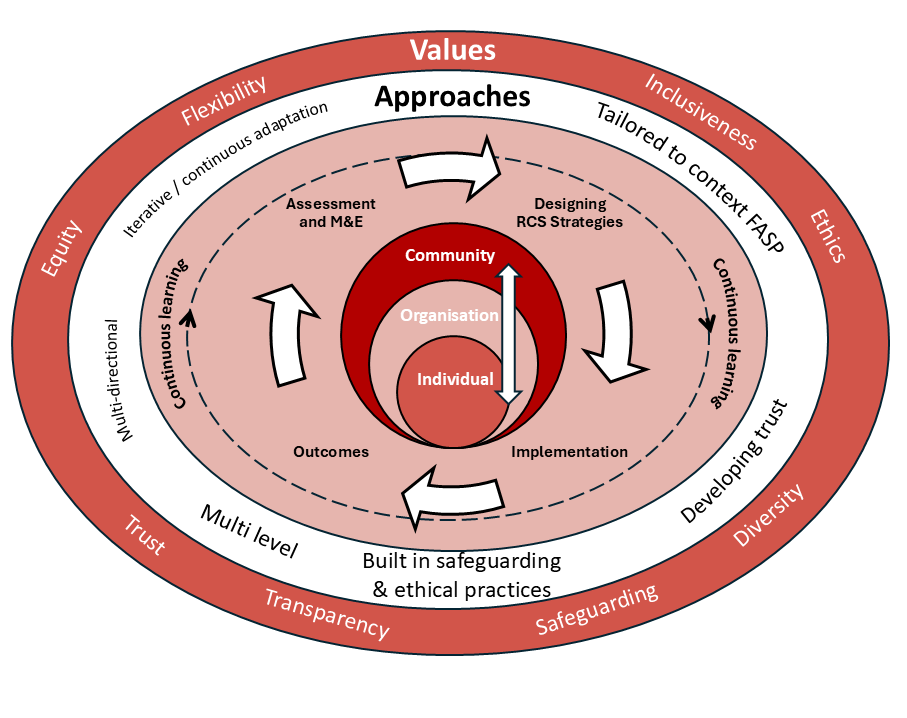
Findings from ReBUILD’s RCS approach demonstrate that context-specific, values-driven, and multi-level RCS strategies can effectively build resilient research ecosystems in fragile and shock-prone settings. This study also proposes an adapted conceptual framework for RCS that emphasizes flexibility, equity, and shared leadership as key to sustainable research capacity development.
Highlights
- Successful RCS in fragile and shock-prone settings requires a flexible and adaptable approach
- Responding to rapidly changing contexts and research teams’ needs is critical
- Continually learning what is effective and what falls short is needed.
- We suggest an adapted framework for HPSR capacity strengthening in FASP settings
Read this Social Science and Medicine – Health Systems paper here [opens new tab]
Suggested citation
Khalil J, Bertone MP, Gautam G, Mansour W, Idriss A, La T, Fouad F, Raven J, Research Capacity Strengthening in Fragile and Shock-Prone Settings: Insights from a Research Consortium, SSM – Health Systems, 2026, doi.org/10.1016/j.ssmhs.2026.100190.
Further information
- ReBUILD has also developed a toolkit for research capacity strengthening in fragile and shock-prone settings – find it here.
- This paper is part of a Social Science and Medicine – Health Systems special edition Developing health systems resilience in fragile and shock-prone settings: Findings from the ReBUILD for Resilience Consortium [opens new tab]