Challenging gender norms through participatory action research: A cross-country study of women close-to-community healthcare providers in fragile settings
Read this Social Science & Medicine – Health Systems paper here [opens new tab]
Background
Despite their critical role in delivering health services in fragile settings, women close-to-community (CTC) health providers, often face marginalisation due to deep-rooted gender norms. This study explores how participatory action research (PAR) can support these women in addressing gendered power relations and enhancing their agency in two fragile contexts.
Methods
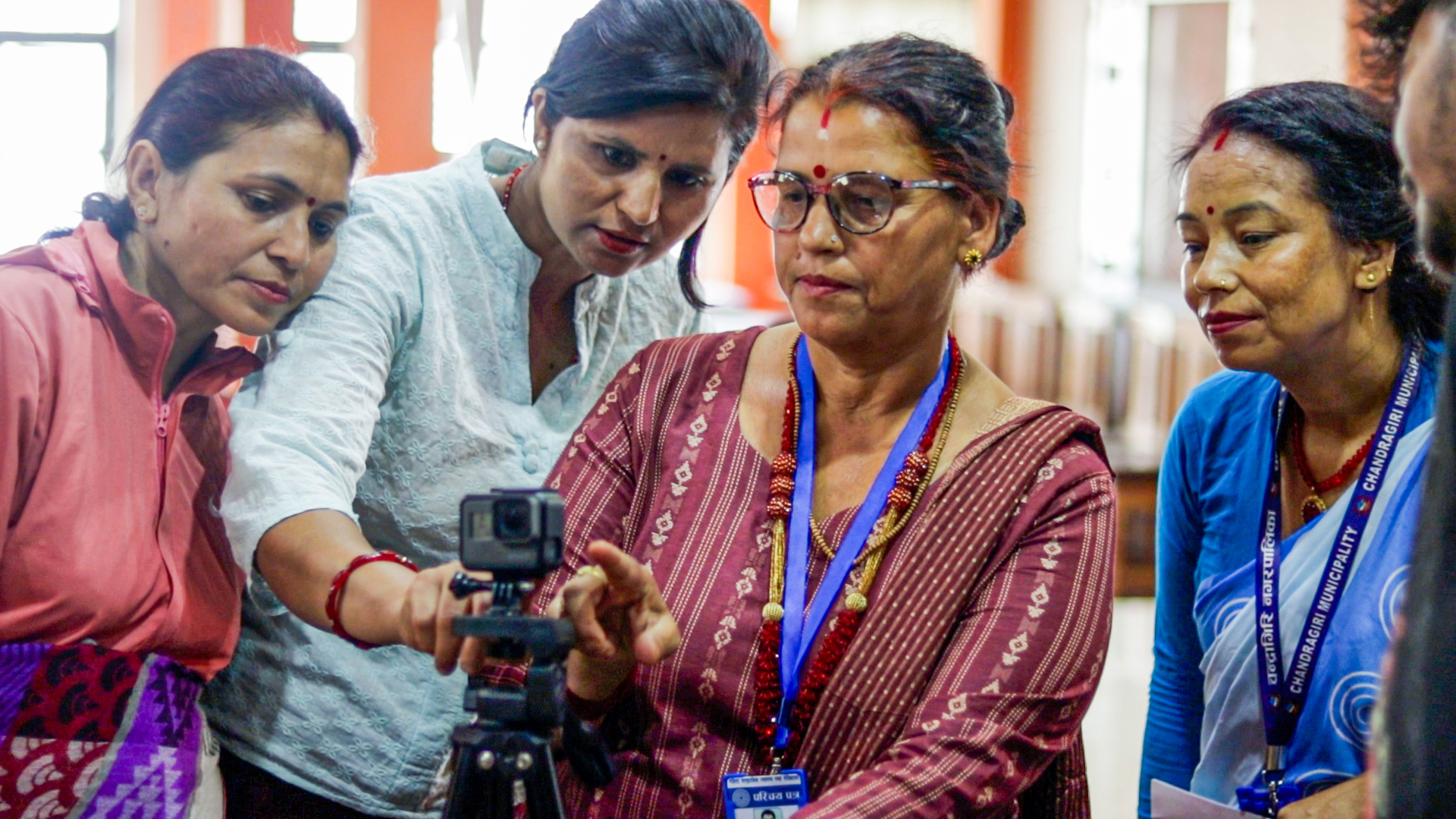
Through a PAR study with women CTC providers in Nepal and Lebanon, a community advocacy film was co-produced and disseminated in Nepal, and a grassroots “Working Women” support group was established in Lebanon. Thematic analysis was conducted to examine the PAR process and its outcomes using the community-based participatory research (CBPR) framework.
Findings
Women CTC providers in both countries shared experiences of being undervalued, limited agency, and gendered constraints. The PAR process enabled reflection on these challenges, build solidarity, and develop context-specific interventions. In Nepal, the film-making process enhanced their visibility, allowing them to challenge community perceptions and advocate for recognition. In Lebanon, the support group created peer networks of 200 refugee women and established childcare systems. Outcomes included increased confidence, community engagement, and policy dialogue. Barriers like legal insecurity, limited resources, and safeguarding risks limited transformative changes.
Conclusion
PAR can act as a powerful tool to challenge and address gender norms and enhance agency among marginalised women health workers in fragile contexts. However, without structural reforms, including legal recognition, fair remuneration, and institutional integration, such approaches limit change. This study contributes to feminist global health literature by showing both the potential and limits of PAR in promoting gender-responsive approaches within health systems and its potential transformative change.
Suggested citation
Mansour W, Yamout R, Arjyal A, Karki S, Khalil J, Baral S, Fouad F, Hawkins K, Theobald D, Raven J, Challenging gender norms through participatory action research: A cross-country study of women close-to-community healthcare providers in fragile settings, SSM – Health Systems (2026) doi.org/10.1016/j.ssmhs.2026.100196.
Further information
- Study: Close-to-community providers addressing gender norms and power dynamics: participatory action research in fragile and shock-prone settings
- Film: ‘Health Workers’
- Film: A Story of Female Community Health Volunteers in Nepal
This paper is part of a Social Science and Medicine – Health Systems special edition Developing health systems resilience in fragile and shock-prone settings: Findings from the ReBUILD for Resilience Consortium [opens new tab]
Image: Female Community Health Volunteers in Nepal, working on their film