Not just a shock: Examining contextual and shock attributes and their impact on health system resilience
Read this Social Science and Medicine – Health Systems paper here [opens new tab]
Health systems in fragile and shock-prone settings are increasingly challenged by the convergence of acute shocks and chronic stressors. Despite growing interest in resilience, there remains limited empirical analysis of how systems respond over time to compound, repeated, or protracted crises.
This paper presents a longitudinal, cross-country comparative study of health system responses to crises in Lebanon, Myanmar, Nepal, and Sierra Leone between 2015 and 2025. Using the ReBUILD for Resilience framework, we map 43 shocks across four domains—climate, conflict, health, and economic—and classify responses into absorptive, adaptive, and transformative strategies.
Our findings affirm that most responses can be categorised within this typology, though distinctions between phases are often blurred. Absorptive responses were frequently overwhelmed or bypassed, particularly in contexts already experiencing chronic stress. Adaptive responses, such as service reorganization and decentralized decision-making, were more common and sometimes sustained. Transformative responses were rare but observable, particularly where prior learning, institutional flexibility, and governance reforms were present. We also find strong evidence that response strategies often co-occur and are shaped by prior exposure to shocks, political context, and system capacities.
This study contributes new empirical evidence to global health resilience debates, emphasizing the importance of context-aware, historically-informed, and equity-driven approaches to system strengthening in crisis-affected settings.
Suggested citation
Diaconu K, Moussallem M, Gautam G, Regmi S, La T, Osborne A, Yamout R, Baral S, Witter S, Not just a shock: Examining contextual and shock attributes and their impact on health system resilience, SSM – Health Systems,
7, 2026, doi.org/10.1016/j.ssmhs.2026.100264.
Further information
This paper is part of a Social Science and Medicine – Health Systems special edition Developing health systems resilience in fragile and shock-prone settings: Findings from the ReBUILD for Resilience Consortium [opens new tab]
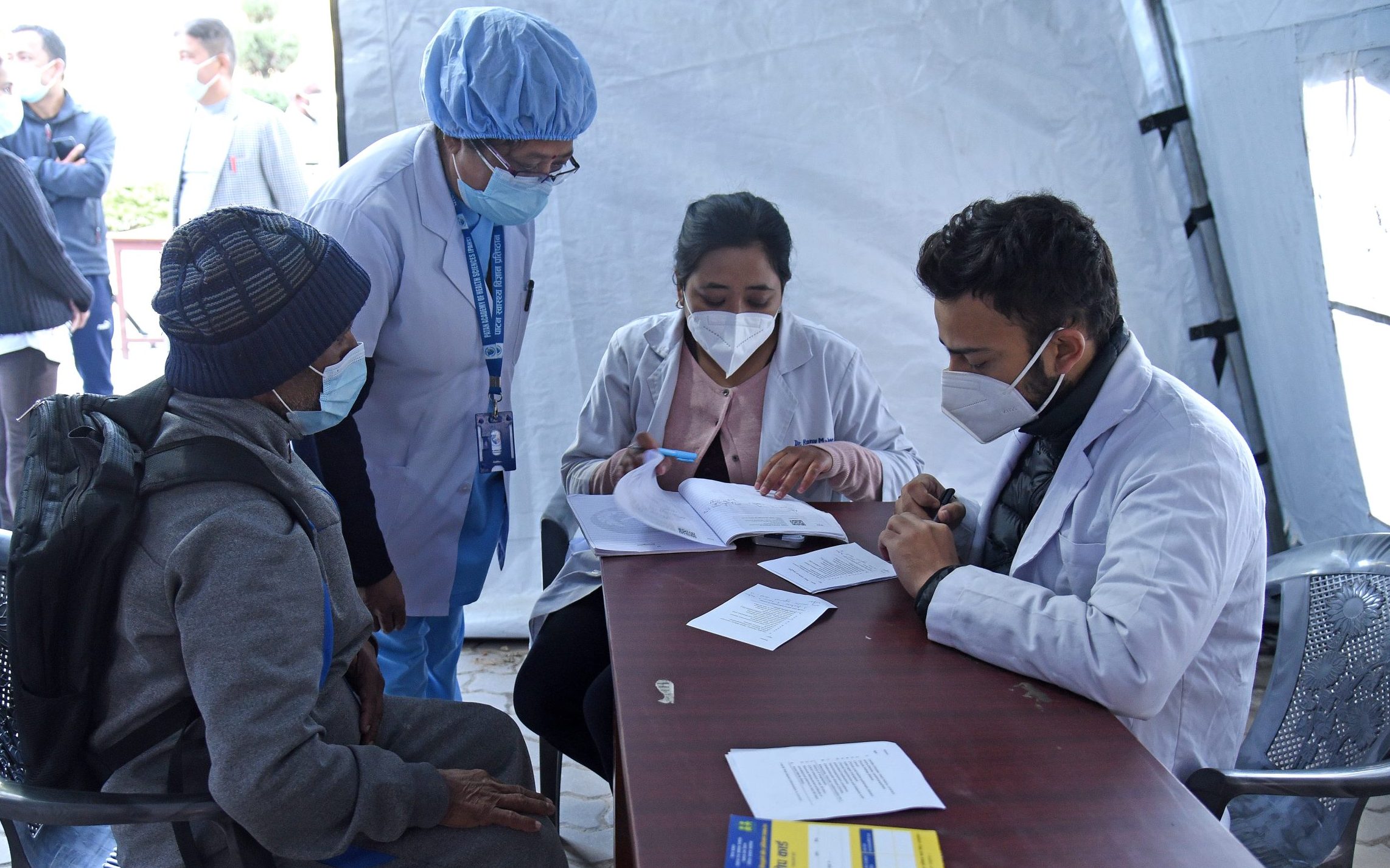
Image: Patient receives a COVID-19 vaccine and health workers help ensure his paperwork is complete at Patan Hospital in Nepal. USAid via Flickr [opens new tab] CC BY-NC 2.0 DEED. Attribution-Non Commercial 2.0 Generic