Bridging multi-tiered health systems, strengthening coordination and promoting a culture of learning in Nepal
Background
Federalization in Nepal led to a significant transformation in governance, establishing a three-tier government structure comprising federal, provincial and municipal (local) governments. While decentralization aims to bring services closer to communities in all sectors, including health, it has also presented coordination and governance challenges. There is evidence (see Wasti et al (2023) [opens new tab] and Regmi et al (2024)] indicating insufficient coordination among the three tiers of government and an absence of formal platforms that facilitate their engagement in joint planning and policy dialogue to address health issues. Although municipalities generally align with broader provincial and national policies and guidelines, they often function independently. As a result, the local health systems operates in a fragmented manner.
Under federalism, provincial entities such as the Health Office (HO) and District Coordination Committee (DCC) are responsible for facilitating inter-municipality coordination. The DCC holds meeting with Mayors to discuss broader development agendas, while the HO organizes meetings with Health Section Chiefs focusing on health issues. However, in practice, facilitation of routine coordination by both entities is affected by resource constraints and a lack of mechanisms to create accountability. In the absence of mechanisms to ensure compliance, track progress and share lessons, local governments are largely self-regulating in their plans and approaches.
What problem is being addressed?
In Kapilvastu district, where ReBUILD for Resilience’s learning site 1 in Nepal is situated, municipalities operate within similar contexts of socio-economic challenges, characterized by poor education and economic status, low institutional deliveries, insufficient health infrastructure and resources, and poor health service utilization. Furthermore, there is limited strategic collaboration in the development of health programmes. The absence of platforms to facilitate dialogue horizontally (among municipalities) and vertically (across tiers) limits the opportunities to develop coordinated strategies, promote complementarity and support resource sharing in health care arrangements to strengthen local health systems.
What did we do?
In response to these challenges, the ReBUILD research team from HERD International established a multi-tier coordination mechanism within Kapilvastu district that enabled dialogue, collaboration and joint problem solving across three tiers of government and among all ten municipalities. This approach was integrated within the learning site 2 initiative, aiming to strengthen local health systems through coordination, learning and policy engagement. The activities implemented within this initiative included:
Bilateral meetings and consensus building
The research team initiated a series of consultations with key stakeholders at the federal, provincial and district levels. They visited several municipalities to gather insight into systemic and coordination challenges and the appetite for a cross-municipality learning platform. The team also held a joint meeting with the Secretary of the Federal Ministry of Health and Population, Provincial Health Directorate Chief and Chiefs of the HO and DCC. The discussions focused on identifying coordination gaps across the municipalities and government tiers and exploring the feasibility of creating a multi-tier coordination platform. These meetings resulted in a willingness and consensus among the stakeholders to engage in routine dialogues relating to local health systems issues, challenges and practices.
Operationalization and meetings
Based on the agreement with key stakeholders, the research team facilitated the creation of a multi-tier coordination forum to bring together federal and provincial governments and representatives from all local governments within Kapilvastu District, namely Mayors and the Health Section Chief. At the time of writing (April 2025) two meetings had been held (one in financial year 2023/24 and another in 2024/25). A third meeting was planned, ahead of the local annual planning and budgeting cycle, with the aim of prioritizing health in local plans and budgets. These meetings provide a space for municipalities to share experiences, discuss common issues, and engage with the province and federal governments on policy and implementation challenges.
Follow-up engagement and support to municipalities
In addition to joint meetings, the ReBUILD research team has been visiting municipalities individually to explore challenges and understand expectations for strengthening health systems. These visits help to identify gaps, specific needs, and existing capacities to provide tailored support for health system strengthening.
Immediate outcomes
The multi-tier coordination forum was operationalized through interactive meetings, coordinated by the DCC. The first meeting was held on November 28, 2023, with representatives from all tiers of government. The meeting focused largely on maternal health issues – one of the key concerns for the local governments since the 2021 National Census reported Kapilvastu District as having one of the highest rates of maternal mortality in the country. At the conclusion of this meeting, all local governments signed a five-point commitment focused on strengthening maternal health services and eradicating maternal mortality in Kapilvastu District.
The commitment did not just remain on paper, but it was translated into local government plans and actions. Several municipalities increased their focus on maternal health activities by prioritizing community level actions. Local governments have also allocated budgets to upgrade available maternal health services and invest in community-level awareness programmes on maternal and child health issues to promote institutional deliveries.
During the second meeting, held on December 22, 2024, local stakeholders shared innovative approaches implemented in their municipalities, along with experiences and lessons learned. This platform promoted cross-municipality learning, and even a sense of healthy competition, as stakeholders realized the possibility of implementing locally-led solutions by utilizing local resources. The meeting also highlighted the crucial role played by local policy makers in translating plans into action. Some municipalities approached the municipality stakeholders (of learning site 1) to seek support and guidance to replicate innovative and successful practices, such as a mobile-based, community-level pregnancy tracking system.
In addition to exchanging ideas and experiences across municipalities, both meetings provided an opportunity for dialogue among the three tiers of government. Local governments were able to present challenges around service delivery, resource limitations and coordination gaps directly to provincial and federal stakeholders. This in turn allowed federal and provincial governments to acknowledge the issues raised, provide clarifications where needed, and commit to addressing these issues in future policy discussions. For example, when municipalities raised the question of budget allocation for health from the province, the provincial Health Secretary clarified this misunderstanding by explaining that the current system does not allow the province to allocate health budgets directly to local levels, but that programme funding must be channelled through the Health Office. The province also presented a solution where local governments can apply for special grants based on their needs and encouraged them to plan accordingly.
“Following the last meeting, I felt motivated and became more proactive. I have been discussing these (maternal health) indicators during municipal executive meetings and with health workers, emphasizing the status of our municipality and the district. I also asked them how we could improve these indicators and outperform other local levels.” Municipality Mayor
Impact
While still in the initial stages, the coordination forum represents an important step toward more responsive and coordinated health governance at a subnational level. This is evident from our findings as local governments have started integrating health activities into their annual plans as per the follow-up actions from the coordination meetings. Looking ahead, we anticipate several long-term benefits from this initiative:
- One of the key anticipated impacts is stronger cross-municipality coordination and exchange of experiences and learning which can lead to an integrated approach to strengthening health systems and building resilience.
- The coordination platform will help facilitate efficient resources mobilization and pooling of specialized health care services across municipal boundaries. Therefore, all municipalities will not have to establish all types of specialized health care facilities in their own municipalities and can arrange service provision more strategically, improving service quality and efficiency.
- This platform will also enable faster and more coordinated responses to emergency management by leveraging resources and experience.
- Regular dialogue has allowed local governments to share implementation-level challenges directly with provincial and federal stakeholders. This process will support the strengthening of existing coordination mechanisms across the tiers, and inform policy refinement and structural adaptation.
Further information
- More on the study at the second learning site in Kapilvastu
- More on the work undertaken in the first learning site
- There are other ReBUILD for Resilience case studies here
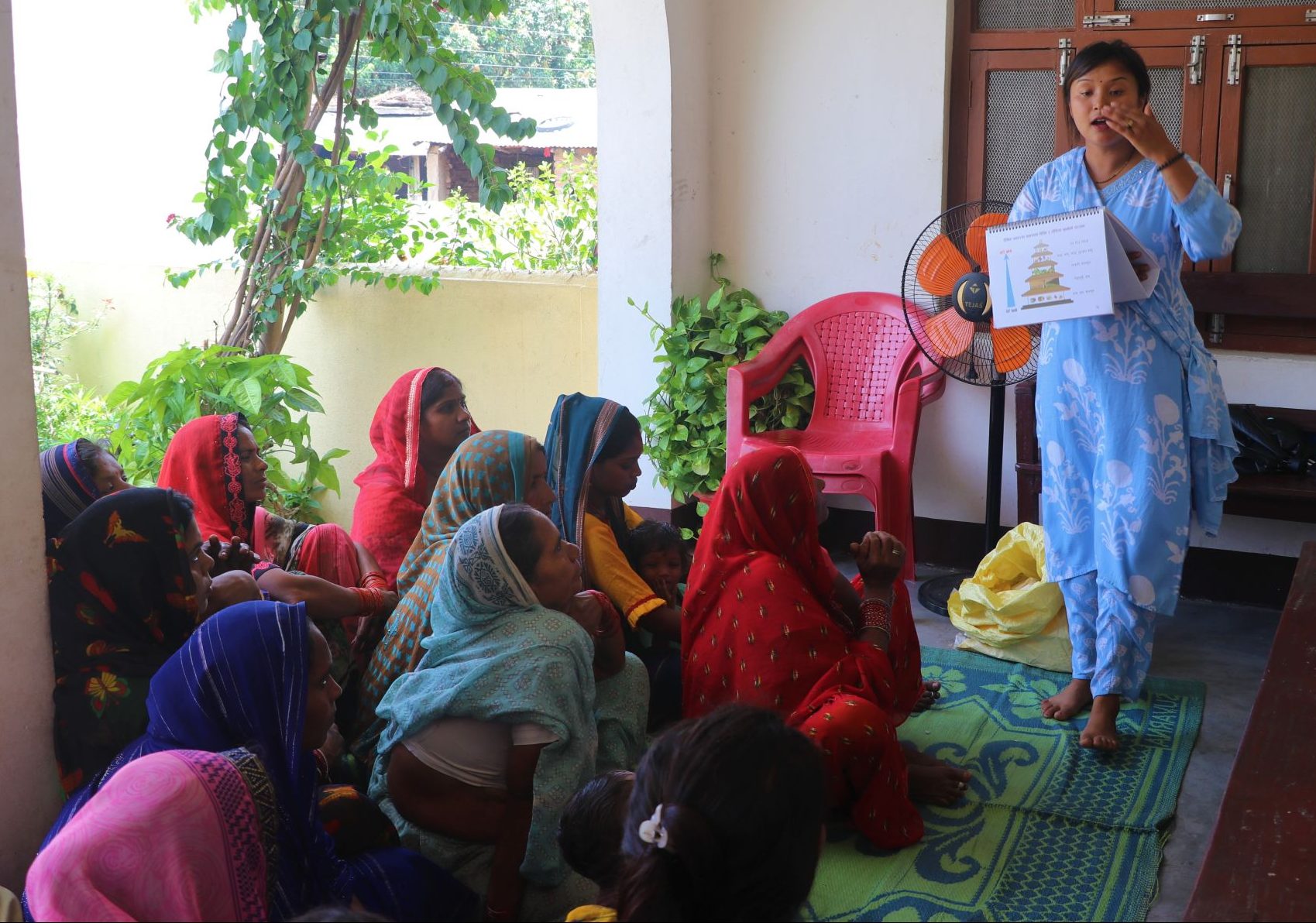
Image: A mothers’ group takes part in a discussion on optimal nutrition and family planning for pregnant women and new mothers in Kapilvastu Municipality (learning site 2). The meeting is led by a Female Community Health Volunteer trained by HERD International and using a flipbook designed by HERD and supported by the ReBUILD for Resilience consortium.