Data-driven local governance for health: How participatory research strengthened the Municipal Health Committee in Lebanon
Background
In the Beqaa Valley, in Lebanon, the Municipal Health Committee (MHC) of Majdal Anjar is redefining grassroots health governance. Over the past three years, the MHC has co-developed and implemented a municipal-level, context-specific, evidence-based governance model focused on local decision-making for health, solid health data , and thorough follow-up for all residents to reach equitable access to essential healthcare and improved health outcomes. It has been supported in this by the ReBUILD team at American University of Beirut and the participatory action research (PAR) model that they have used.
This case study builds on two earlier studies focused on training and promoting evidence-based governance among MHC members (see ‘further information’ for more), to explore how the MHC operationalizes ReBUILD-generated tools and learning to monitor and coordinate health activity through the creation of actionable data and promoted uptake by local, national, and international stakeholders. This has created a replicable, community-led governance model with increasing external recognition.
What problem is being addressed?
Since the beginning of the multicrisis, Majdal Anjar has faced complex socioeconomic and health challenges, worsened by fragmented services and the absence of reliable population-level data. Through a process which used PAR, the MHC was co-established as a multi-stakeholder body embedded in the municipality. Grounded in community engagement and informed by iterative learning cycles, the MHC designed its mandate to coordinate, analyze and act on local health data. Its structure and practices reflect the co-produced knowledge from ReBUILD-supported health plans, health system mapping and governance reviews.
Working with schools, local and international NGOs, private clinics, hospitals, and volunteers, the MHC transformed local knowledge into validated health insights supported by real data — enabling equitable, sustainable, trackable and resilient interventions.
What did we do?
Building a culture of evidence-based rigor
The MHC institutionalized data collection and use across all community health activities, following principles co-defined during participatory planning with ReBUILD. Simple yet strategic tools, including targeted electronic surveys, documented meeting minutes and digital tools (e.g. WhatsApp), are used systematically to coordinate referrals, share results and inform real-time decisions. This culture of data use reflects both research outputs and behavioral shifts tracked through the learning site process.
Implementation: Data in action
The MHC follows a structured, agreed-upon, research-informed cycle for initiatives:
Capacity building → Community screening → Analytical review → Targeted intervention, including population-wide screening, health education, targeted referral → Feedback loop
This evidence-to-action model was refined through ReBUILD’s engagement and is now being adopted by partner organizations (more on that uptake here), demonstrating the practical uptake of research. Below are examples where the evidence-based approach was successfully applied.
1. Schools as evidence hubs
The School Health Plan assigns a focal point to each school to coordinate the annual medical visit. Trained school staff and volunteers assess for sensory, dermatological, oral, musculoskeletal, learning and mental health issues that do not require a physician. Annual doctor visits performed by local volunteer doctors are reserved for more complex conditions such as cardiovascular, respiratory, renal and hepatic issues. Screeners refer flagged cases to qualified providers under MHC oversight.
As part of this broader plan, the MHC launched a dental health initiative across nine of Majdal Anjar’s 13 schools, targeting children aged five and eight. Each school trained a focal point to screen oral health in four elementary classes. A total of 480 students were screened and the data results were entered on an electronic tool specially designed for this purpose. Of those, 155 required follow-up dental care and were referred to local dentists offering treatment at a 50% discount. MHC tracks referrals and follows up with parents whose children did not show-up on referral time, to understand barriers and promote engagement.
2. Virtual blood bank
Emerging from real need expressed through discussions with the community, the MHC developed a virtual blood bank using an online survey and WhatsApp coordination. This intervention transformed community-identified needs into a sustainable emergency response mechanism. The verified donor registry of 224 individuals is now operational and integrated into the emergency protocols of regional health actors, marking direct uptake of co-generated solutions.
3. Chronic disease mapping
To improve access to medication for chronic conditions, the MHC conducted a village-wide electronic survey using a tool co-developed with technical support from ReBUILD. The survey gathered more than 1,200 responses to identify individuals with chronic conditions and assess their access to chronic medications and eligibility for assistance. A detailed data analysis — factoring in socioeconomic status, age and marital status — was used to prioritize the most vulnerable patients. As a result, 445 high-priority individuals were approved by ANERA (American Near East Refugee Aid) — a key MHC partner — for enrolment in its free medication program, operated through the Gherass el Kheir health center – another MHC partner. These patients were referred to the center, which monitors their follow-up and shares regular updates with the MHC. For those who do not attend, the MHC plans to investigate and re-engage them. A continually updated chronic patient registry helps sustain equitable access through NGO partnerships, reflecting the MHC’s strategic use of data for long-term health system strengthening.
4. Breast cancer awareness and screening
Following the death of a young woman from breast cancer and the resulting community distress, the MHC launched a Breast Cancer Early Detection Plan. This initiative was also motivated by population data revealing low uptake of routine mammography due to financial barriers. The initiative includes awareness campaigns, training women on breast self-examination (BSE) and training healthcare providers on clinical breast examination (CBE). Trained staff at the Karagheusian Health Care Center began collecting feedback from women who received BSE training using electronic surveys. Women reporting abnormalities during self-examination are invited for clinical evaluation, and those with suspicious CBE findings are referred for mammography at a 50% subsidized rate through partner hospitals. Within two months, 16 women were referred, six completed a mammography, and one remains under investigation for suspected early-stage breast cancer. The health center has now widened BSE training with the goal of reaching all female dwellers from 15 years of age, oversees ongoing data collection, and shared that data with MHC and referral processes to ensure continuity.
Impact
- School staff are implementing evidence-led screening and referral systems.
- Blood donation is coordinated in real-time using digital tools co-designed with community input.
- Data sharing enables better coordination between the municipality and NGOs.
- Hospitals and international NGOs rely on MHC data to inform their programming.
- The MHC model was presented at a regional meeting, gaining recognition as a ReBUILD for Resilience-driven example of local system strengthening.
At the inception of the MHC, and with the mentorship of the AUB ReBUILD team, it was decided that Majdal Anjar needed more than basic services — it required a structured, data-informed governance model, capable of generating, interpreting and acting on health data. That is being achieved, however, challenges remain. Not all stakeholders report consistently, and a culture of anecdotal, donor-driven data persists. Yet, through the PAR process, MHC continues to advocate for transparent, validated systems.
Conclusion
In just three years, the Majdal Anjar MHC has demonstrated that impactful local health governance can be achieved through the strategic use of simple digital tools, community engagement, maintenance of a centralized data basis and a commitment to evidence-based practice. At the core of its success is the systematic generation and use of population-level health data, which now informs planning, resource allocation, and service delivery. The MHC has established a growing, community-owned health data infrastructure — from chronic disease registries and school screening databases to referral tracking systems and digital feedback tools. This evolving data ecosystem strengthens local accountability, enables more targeted and equitable interventions, and positions the MHC as a credible, evidence-informed partner for national and international stakeholders. As a result, Majdal Anjar is not only improving health outcomes but also building a replicable, data-driven governance model aligned with the ReBUILD for Resilience framework.
Further information
- More on the development of the learning site in Majdal Anjar
- The two case studies mentioned above:
- There are other ReBUILD for Resilience case studies here
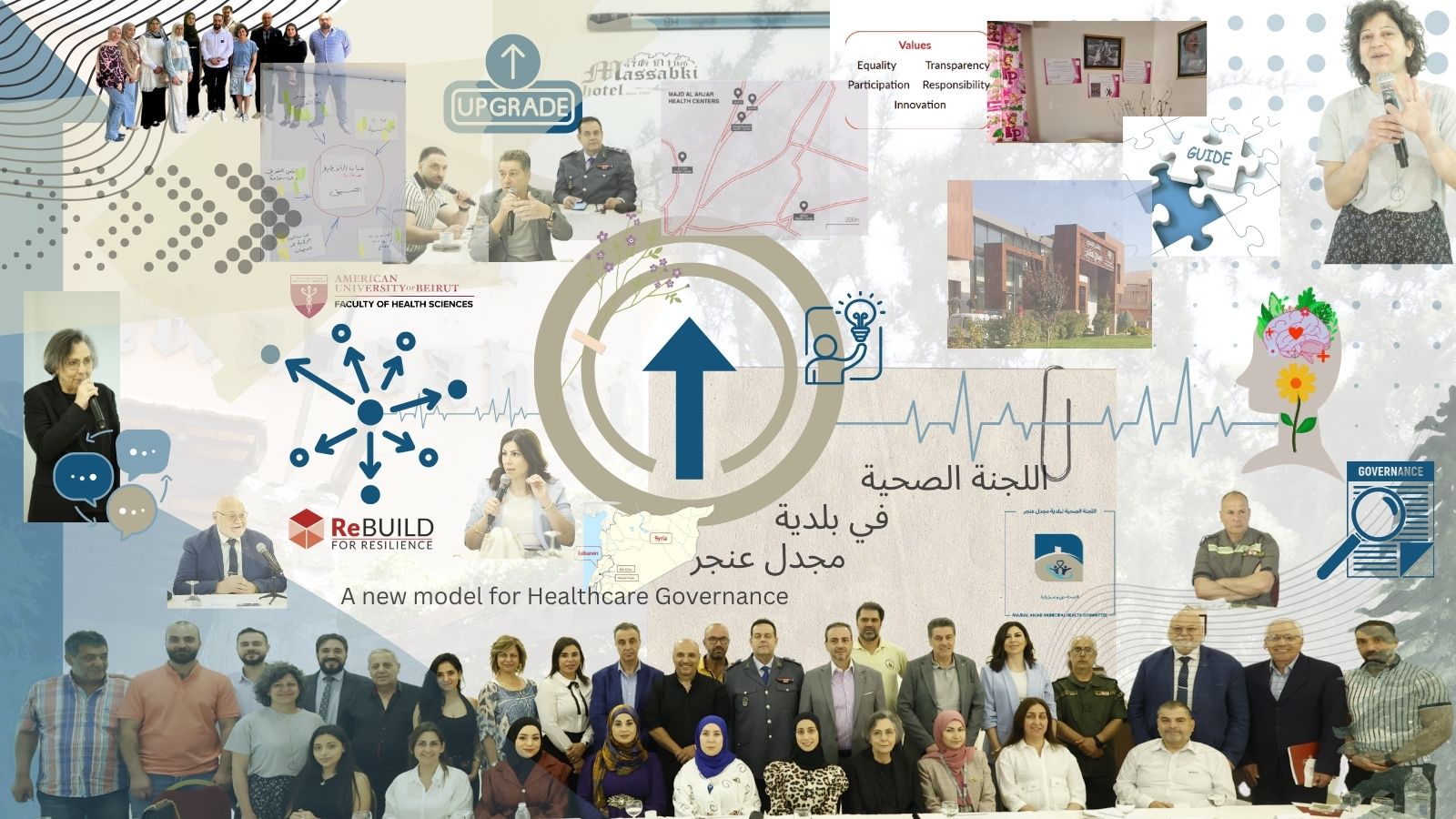
Image: A collage produced by the American University of Beirut team which shows the people and process involved in creating the Majdal Anjar Municipal Health Committee