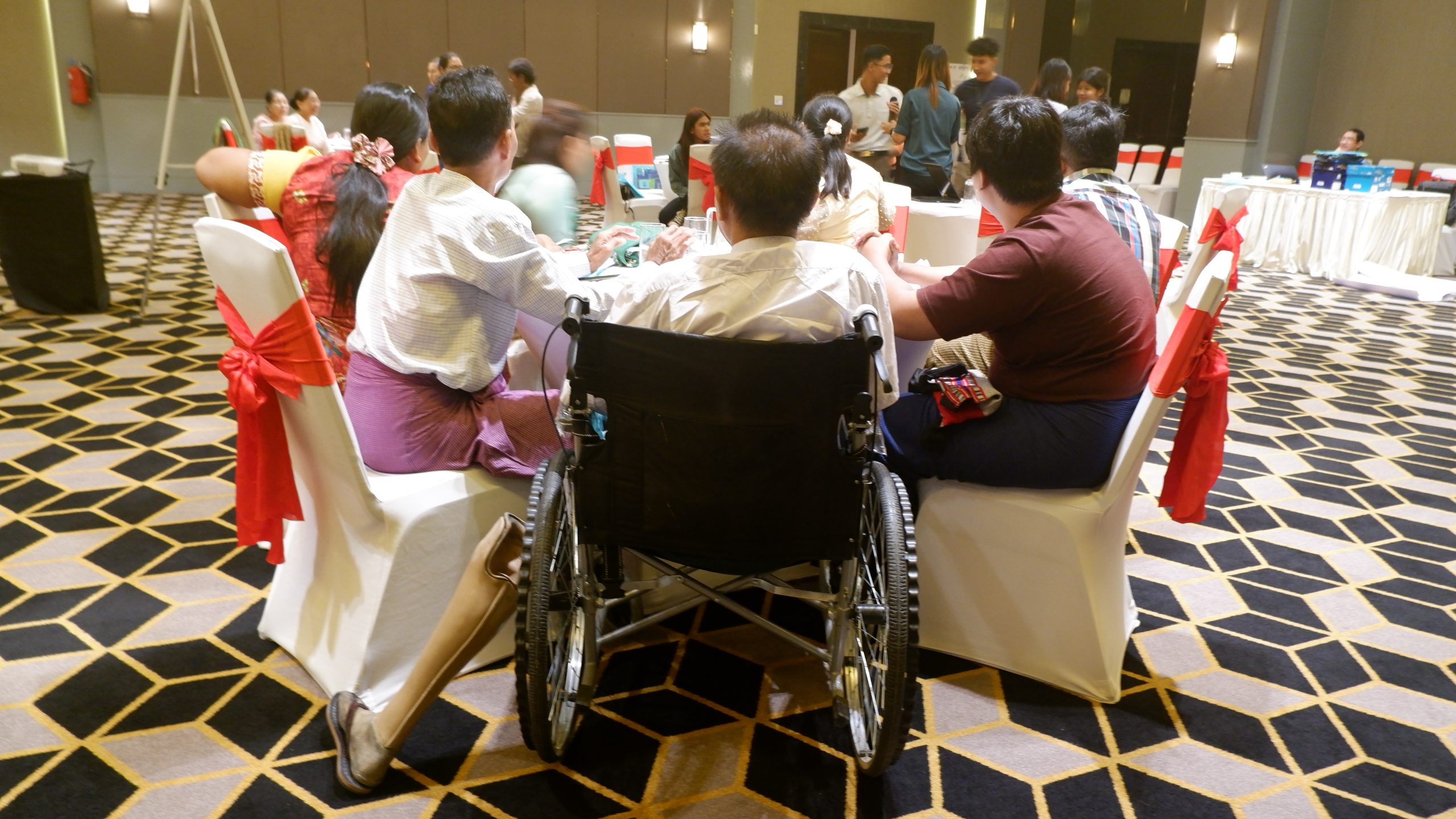
The inclusion of people with disabilities in health system building at community level
Background
Disability is a result of the interaction between a condition-based limitation and barriers in the environment. According to WHO estimates, 1.3 billion people worldwide, or 16% of the global population, experience a disability that significantly impacts their daily lives and participation. The available evidence indicates that adequate access to healthcare for people with disabilities can improve health behaviors, prevent secondary conditions, delay the progression of disabilities, and enable early intervention through the timely detection of diseases which might improve health outcomes (Krahn et al., 2024).
The health inequities faced by people with disabilities are not only due to their physical and/or mental conditions but also significantly exacerbated by societal factors, including limited access to quality education, healthcare services, economic disadvantages, and pervasive stigma and discrimination (WHO, 2022).
Increasing the amount and coordination of disability research and routinely including people with disabilities in general health research will help close the knowledge gap on effective interventions (Krahn et al., 2024) In Myanmar, the need for such research is especially urgent as it has become increasingly difficult for people with disabilities to access healthcare in recent years (Khan et al., 2024)
What problem is being addressed?
Disability inclusion in health research can be challenging in contexts of political, economic and social fragility. Since Myanmar’s military coup in February 2021, the health system, which was already fragile, has collapsed further, severely impacting people with disabilities. They often face financial barriers to accessing the few remaining services, and many have been forced to forgo necessary treatments. With limited access to essential health care, they have to rely on selfcare, and community support with scarce financial resources.
South Dagon Township, located on the eastern fringe of Yangon, is a peri-urban area characterized by rapid urbanization, socioeconomic inequality and limited public infrastructure. Many residents live in informal or low-income housing, and access to essential services, such as healthcare, education and transportation, is constrained. People with disabilities face compounded vulnerabilities in this environment due to physical, social, and institutional barriers. Although Myanmar ratified the United Nations Convention on the Rights of Persons with Disabilities (UNCRPD) in 2011, disability inclusion remains limited in practice, especially in peri-urban townships like South Dagon. This case study examines the contextual challenges and opportunities for promoting disability-inclusive community-based health systems in this and similar townships.
What did we do?
ReBUILD partner Burnet Institute Myanmar has worked in South Dagon Township for more than ten years. This research project aimed to examine the barriers that people with disabilities face in accessing the health system in order to co-design interventions to make the system more holistic. Burnet Institute Myanmar started to involve people with disability in the development projects since 2022 under the Australian AIDS project activities. This allowed for prior trust building among communities of people with disabilities. Development projects also engaged with organizations for people with disabilities and built momentum in terms of inclusivity and participation. At the start of interactions with stakeholders, we ensure that we include organizations for people with disability in the township and consider their active participation and involvement. During these initial stages of stakeholder engagement, we realized that the voices of people with disability were often soft and passive compared to other stakeholders with funding, research projects and authoritative positionings.
The Burnet team also learned that disability inclusion is not just a concept, nor mere participation of people with disability in research and development work. As a research and development organization, Burnet needed to learn much more to be inclusive. Therefore, a series of training sessions was held for Burnet Myanmar staff covering disability awareness (10 Dec 2023), disability inclusion (16- 18 Dec 2024) and orientation sessions on disability accessibility (30 May 2025) with experts in this area. The team learned not only the concepts but also how to consider the needs of people with disabilities, terminology to use and how to be inclusive and sensitive.
Effective inclusion requires a two-pronged approach; not only to understand and effectively include people in research and development work but also to build the capacity of disabled people’s organizations and their members. In South Dagon township, the organization of people with disabilities was developed in 2010, but often acted as a passive partner in the development sector as it was not well equipped with funding, human resources and organizational development. The organization was developed more on a voluntary basis with a loose management structure.
While improving understanding of disability sensitivity and inclusion, the Burnet team also assisted in reviewing the organizational structural and individual capacities of its members. Reviewing the organizational strengths, weaknesses, opportunities and threats, they were able to conceptualize their organizational needs and prioritize what capacities should be strengthened to be truly inclusive into the community health system, together with non-state actors. The team assisted the organization with disability in the development of inclusion concepts, such as Protection from Sexual Exploitation and Abuse (PSEA) and Gender Equity Disability Inclusion (GEDI) trainings, leadership and communication skills, project cycle management, MHPSS and community engagement training.
The process of building the inclusive capacity for both organizations and their people is an important step for disability inclusion to be more inclusive, effective and mutually understanding.
Results
As the team moved to the co-design stage, they listened to the organization for people with disabilities who reported that many of the organizations working in the township ask for their data and for them to collect specific data (e.g. UNICEF collected data on children with disabilities). Although many people with disabilities participated in the data collection, data were never shared and so could not be used by them. Therefore, Burnet trained the organization and its members on the fundamentals of research, data collection techniques and how to collect quantitative data using the Washington Group Questions on Disability adapted to the Myanmar context. The organization and its community volunteers also collected data on 2,250 persons with disabilities– this would help them understand how many people might require activities in the future. Burnet led the analysis of the data but went through the descriptive analysis with the organization so that staff were confident presenting to local stakeholders. The organization is now advocating for this data to be used to inform future planning and activities.
Stakeholder analysis, using social network analysis, was also undertaken with the people with disabilities and all health-related organizations working for the township. This helped to understand the network structures and how to encourage people with disabilities to actively participate in the health system. Also, township coordination committees were revitalized through the active participation of people with disabilities. This stakeholder analysis is a particularly important step in the current political scenario because there is no government involvement. The organization for people with disabilities has now taken an active role in advocating for the inclusion of disability in the health system at community level.
Impact
Disability inclusion in community-based health systems in South Dagon Township remains challenging but not impossible. By addressing structural barriers, empowering people with disabilities and strengthening service delivery, stakeholders can ensure that people with disabilities are not left behind in Myanmar’s health and development agenda, especially in under-resourced peri-urban areas.
Further information