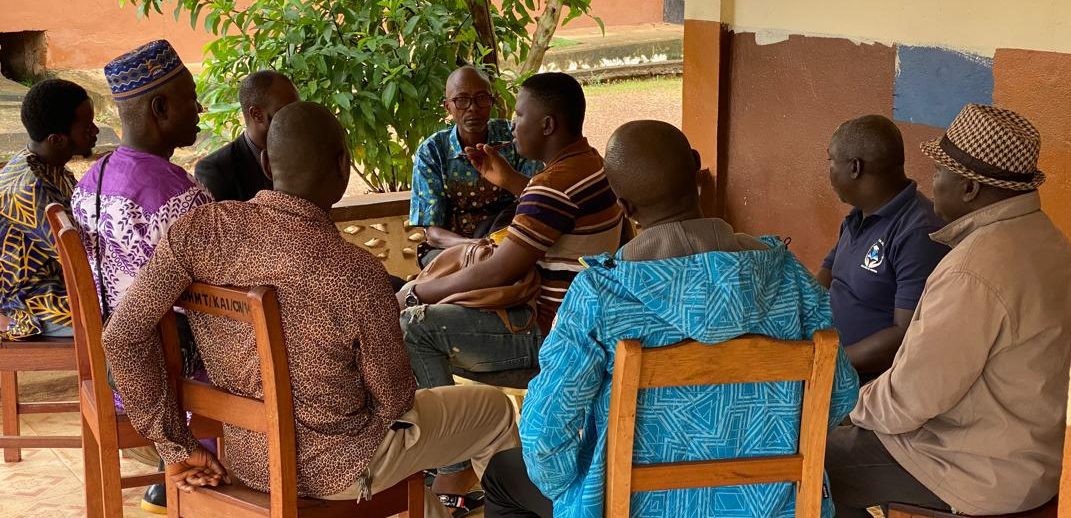
Local stakeholders in Kailahun during the data collection phase
“Kush” in Kailahun: What a community-led study is teaching us about hope, health, and hard choices
21 October 2025
Augustus Osborne of Institute for Development tells us about a current study into Kush use in Sierra Leone. In this blog he shares early insights from the team’s ongoing project in Kailahun and why they believe the path forward must be community-driven, practical, and focused on livelihoods as much as on health.
If you live in Sierra Leone, you have heard the word “Kush”. You may have seen its impact on streets, homes, and health facilities. If you aren’t familiar with Kush, it is a highly addictive mixture of cannabis, fentanyl, tramadol and formaldehyde. The effects depend on the user and the particular batch of the drug, but include hallucinations and feeling sleepy or ‘spaced out’. Users can fall asleep while walking, fall over and bang their heads, and even walk into on-coming traffic. In Kailahun district, our team at Institute for Development, in partnership with ReBUILD for Resilience, has been working with communities to understand this crisis and to co-design solutions that work in real life.
What is this project about?
We set out with a simple goal: strengthen how local health and social systems respond to the rise of Kush. We are doing this together with people who are closest to the problem and the solution youth, families, religious and traditional leaders, health workers, local authorities, and civil society.
Our work unfolds in two phases:
- Phase 1: Map what is already happening and ask hard questions about what works and what does not.
- Phase 2: Co-design interventions with communities and partners, then develop proposals to take them to scale.
What we are learning in Kailahun
First, Kush use is widespread and cuts across groups. Our data show very high use in the sample we studied. It is not limited to one age group, gender, or location. This means we should avoid narrow targeting based on demographics. The pattern looks like a community-wide challenge.
One insight really stood out – that work protects. People without work were far more likely to use Kush. Employment appears to be the strongest protective factor. When people have steady work, structure, and purpose, they are less likely to depend on Kush.
Quitting Kush is not just about willpower. Families told us how hard it is to support someone out of Kush use without structured services. There are few rehab options, limited mental health support, and almost no transitional pathways back into training or jobs. Expecting people to quit “on their own” puts an unfair burden on families and ignores the bigger picture.
Finally, Kush is a socioeconomic crisis with health consequences. Yes, Kush harms health, but the drivers we heard most were stress, trauma, joblessness, lack of opportunities, peer pressure, and boredom. If we treat it only as a “drug problem,” we will miss the deeper causes.
So, what could make a real difference?
From community dialogues, interviews, and local mapping, several ideas keep coming up. None of these are quick fixes but they are practical, and communities are ready to help lead them.
Jobs and skills are needed, including:
- Practical skills training tied to real market.
- Support for apprenticeships with local trades.
- Startup support for microenterprises, with mentorship and basic finance.
- Short “earn-and-learn” schemes that offer immediate income and skills.
Safer paths back from addiction are essential:
- Community-based recovery support, not only clinic-based care.
- Transitional programmes that link rehab, mental health support, and work placement.
- Peer support networks for young people leaving Kush.
Prevention must start early:
- Youth clubs, sports, arts, and digital skills to replace idle time with purpose.
- School- and community-based education that is honest and practical.
- Parents and leaders trained to spot early signs and respond with care, not blame.
Stronger coordination are vital:
- A clear district action plan with roles for health, education, social welfare, youth, police, and civil society.
- Community by-laws that focus on prevention and protection, not only punishment.
- Funding that reaches local actors who do the daily work with addicts.
Accountability matters, and we need:
- Open reporting on resources, services, and results.
- Transparent community forums where progress is reviewed and changed if needed.
People in Kailahun were candid about the challenges: weak coordination, underfunded local services, limited rehab and mental health support, and the risk of corruption. Communities also told us they want solutions that outlast projects programmes that they can co-own, not just receive.
What comes next
In the next phase, we will work with local partners to co-design and prioritise a set of interventions that are:
- Community-led and rooted in local strengths.
- Focused on livelihoods and dignity.
- Affordable, measurable, and scalable.
- Built on real demand from young people and families.
We will test what works, learn fast, and share results openly. We will also build the evidence needed to attract sustained investment into what communities say they need.
This matters because Kush is not only a health issue. It is a test of how we value young people and how we invest in their futures. When a community says “we are ready to act”, the right response is to stand beside them with tools, training, and trust.
Join the conversation
- Are you working on youth livelihoods or mental health in Sierra Leone? We want to learn from you.
- Are you a local leader, parent, teacher, or young person in Kailahun or beyond? Tell us what would make the biggest difference where you live.
- Are you a funder or policymaker? Let us show you what scalable, community-driven solutions can look like.
Contact us at Institute for Development. [opens an email]
There’s more on this project here, including a presentation we gave to stakeholders.
Together, we can move from crisis talk to sustained action, grounded in evidence, led by communities, and focused on hope.
Image: Local stakeholders in Kailahun during the data collection phase of the study