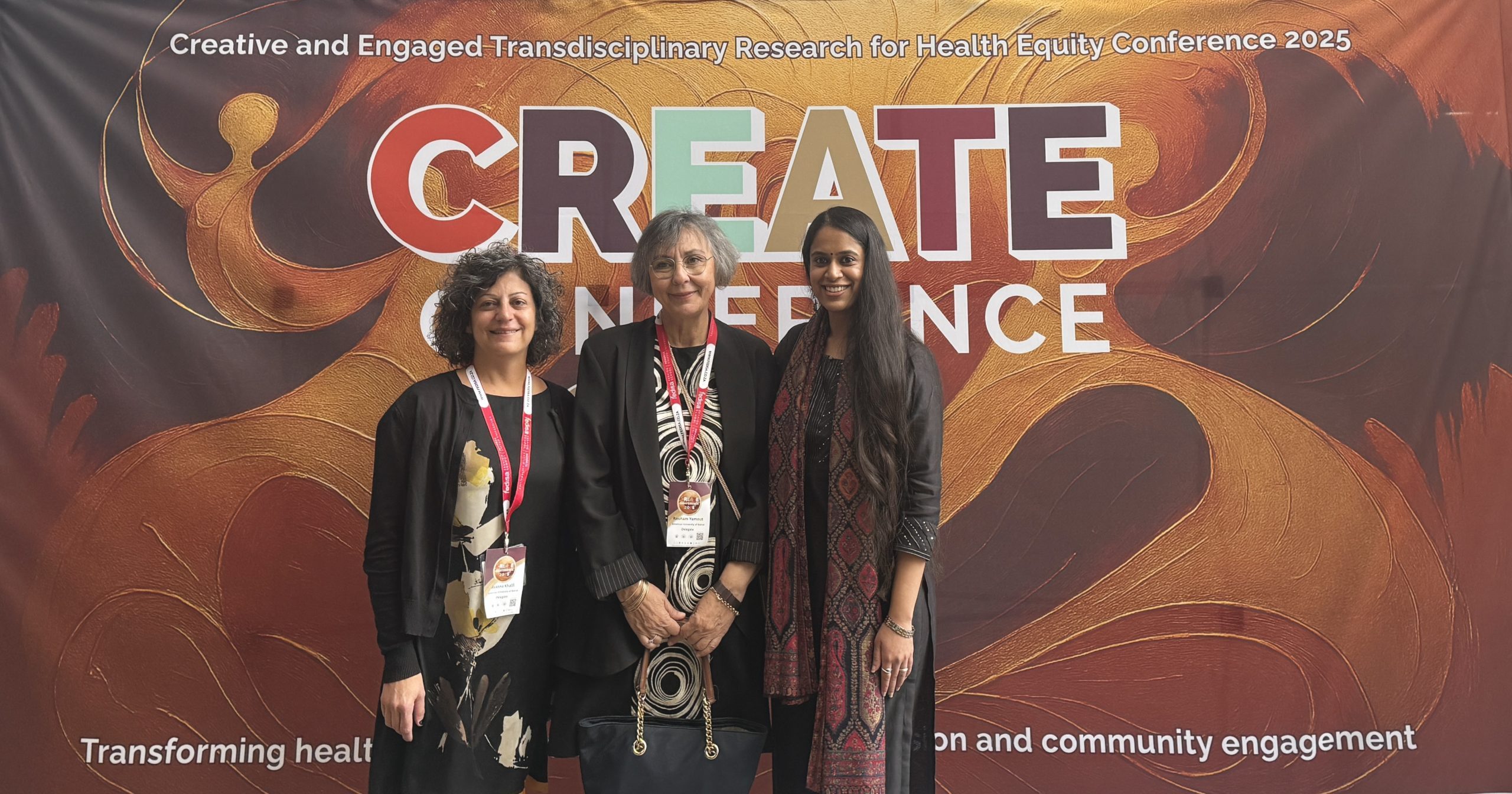
(l-r) Joanna, Rouham and Shrutika at the CREATE Conference
Building knowledge beyond walls: Reflections on creative methods for health systems research
22 October 2025
The authors of this blog were delighted to attend the 2025 International Creative Research Methods Conference in Manchester and the Creative and Engaged Transdisciplinary Research for Health Equity (CREATE) in Africa Conference in Cape Town. These events left Kate Hawkins, Shahreen Chowdhury, Joanna Khalil, Shrutika Murthy and Rouham Yamout with a rich set of conversations, artefacts, andactivis provocations. Across sessions, workshops, and informal exchanges, several themes consistently resurfaced.
Creating safe spaces for trust and emotion
One of the strongest threads woven through the conferences was the importance of safe spaces. Again and again, presenters emphasised that creative methods are rarely quick. They take time, care, and trust-building. But in that slower process lies deep learning: the act of creating together becomes as valuable as any output.
Safe spaces enable emotions to surface and be shared, something creative approaches are uniquely positioned to elicit compared to traditional research methods. Designing with intentionality, not just process, becomes crucial.
Safe spaces also enabled for honest reflections and critical feedback to surface at a public forum. For example, at the CREATE conference, academics, artists, activists, and scientists were forthright in their appreciation, confusion, disagreement, and disappointment around several prickly issues like ownership of creative research methods and data, ethics of co-production, and the legitimacy of creative research methods. Notably, each group was openly critical of the other’s approaches and their own. At CREATE, many of us took away something to reflect upon, especially vis a vis our praxis. Academics needed to reflect on how they had harmed marginalised communities, and think of ways to ‘mend’ ruptured relationships. Artists had to think of ways of gaining greater legitimacy for their methods. Community leaders and activists needed to think more consciously about defining their role in partnerships with academics and artists, while also reflecting on power accumulation among community leaders and their role in gatekeeping.
Yet safe space extends beyond the external world to encompass an often-overlooked internal dimension: the researcher’s own vulnerability. The opportunity to interact with creation freed from scientific framing triggers self-revelation within ourselves. This means accepting the courage required to unveil one’s inner world, such as uncertainties, intuitions, doubts, and subjective experiences, without being intimidated by the weight of rigorous evidence generation processes.
Creative methods, at their best, invite researchers to bring their whole selves to the work, recognizing that the act of making visible what is often kept private, even in its most intimate dimensions, can itself generate profound forms of knowledge that complement, rather than compete with, traditional methodological rigor.
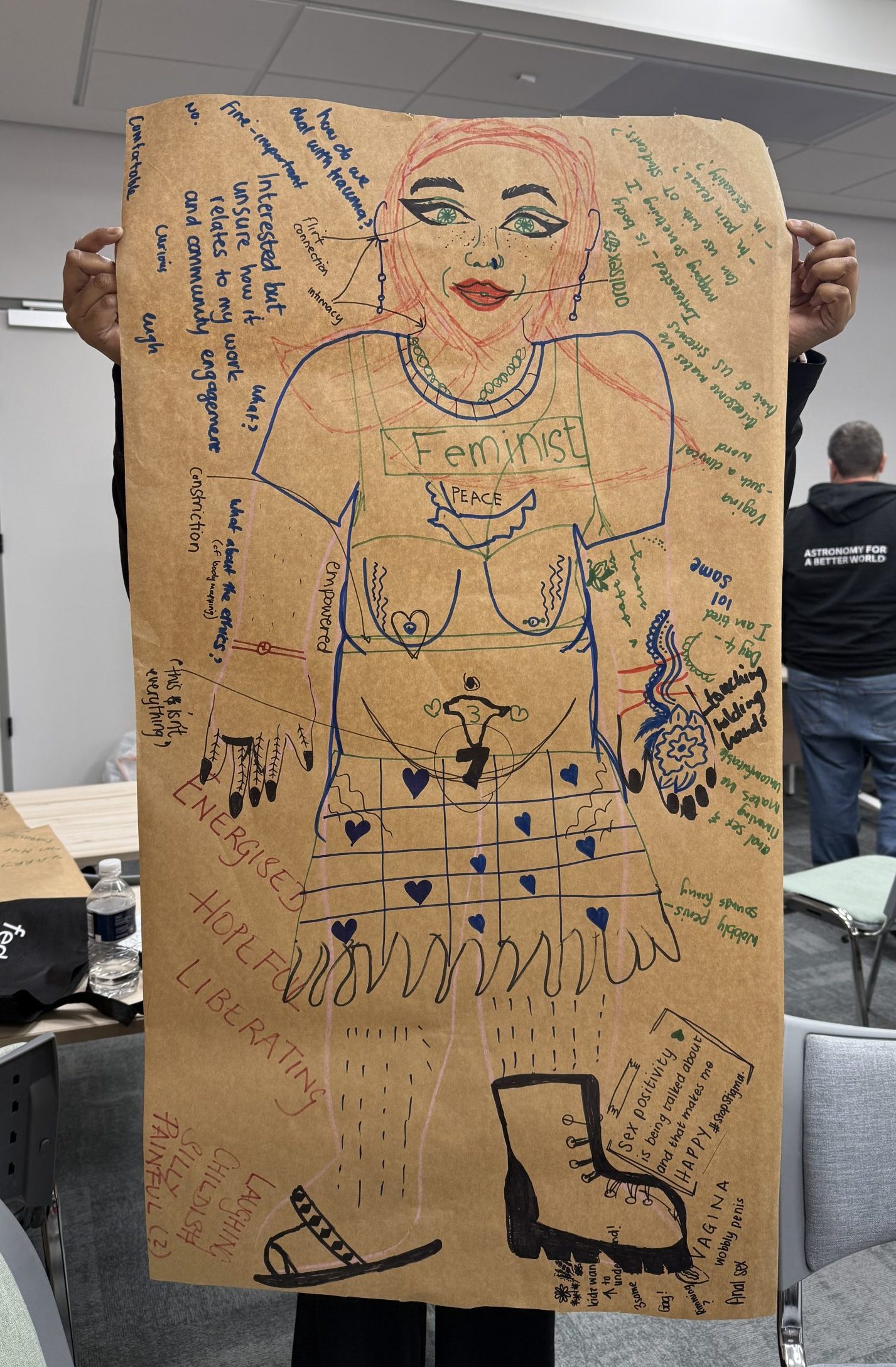 Legitimising creative methods
A recurring challenge was the legitimacy of creative methods within academic systems. Participants spoke about difficulties in “translating” non-verbal work like artworks, performances and games into written words for publication or citation.
This led to discussions about citation itself as a political act. Drawing on Sara Ahmed’s metaphor of “feminist bricks,” some suggested we could be bolder, in citing (inciting) artworks and narratives alongside journal articles. If knowledge is to be built collaboratively, then perhaps our references should reflect the diversity of its foundations.
The question of legitimacy might be reframed beyond the concept of integration. What if we recognized artistic methods as research in their own right? This means accepting that an artist is a researcher too? One who may not necessarily use words and numbers, or who uses them in entirely different ways. A film, a painting, a sculpture, a piece of music, a dance: each questions life, using the entire person of the artist, and inspires corresponding responses to its questioning. Is not this the fundamental act of inquiry?
Artistic inquiry recognizes that reality swings between the concrete and the abstract, between the seen and the imagined, between lived experience and the mystic. This inner reality, made from faith, dreams, sentiments, affinities, and guesses is as important as what can be measured, categorized, and contained in boxes, charts, and tables. Perhaps the challenge is not how to make art more “legitimate” within academic systems, but how to expand our understanding of what constitutes legitimate inquiry itself, to include forms of knowledge that honour the full spectrum of human experience.
Creative approaches to ethics
Several sessions pushed us to rethink research ethics. Could ethics itself be co-created through creative methods? While traditional ethics processes are often perceived as barriers to creative work, participants explored how imagination and participation could shape more responsive and inclusive ethical standards.
At the same time, there were reminders of the weight and responsibility researchers carry. Some methods borrow from therapeutic practices, raising questions about whether trained facilitators or support staff should be present when work becomes psychologically demanding. Here, interdisciplinarity—bringing in artists, therapists, or health professionals—was suggested as a way forward.
This signals a deeper shift: if we recognize artistic inquiry as research, then ethical frameworks must evolve to reflect the emotional and relational dimensions that creative methods bring to the surface, since participants and researchers participate in artwork, and are called to reveal parts of inner thought. In this context, the concepts of consent, privacy, anonymity, and confidentiality require rethinking to correspond to the exhibitionist, interactive, and longitudinal nature of creative research. In this work, researchers themselves become vulnerable since they engage alongside participants. Consequently, they are equally entitled to ethical protection and care. Moreover, creative methods often blur the boundaries between research and relationship-building within collective art creation, as connections deepen through the ongoing processes.
Process, product and participation
A powerful insight was that process often matters more than product. Whether creating body maps, collages, or poems, the act of making together can spark conversations and reflections that might not otherwise emerge. In traditional research there is a great emphasis on the product – usually the peer-reviewed journal article – and in the process of reifying this kind of research output learning may be lost or overlooked.
The aesthetic power of creative outputs should not be underestimated. Art, music, or performance can move audiences in ways traditional reporting cannot. They hold multiple realities simultaneously, inviting audiences into forms of knowing that resist cliches and conditioning. This duality—valuing both process and product—was echoed throughout.
Importantly, participants reminded us that “participation” does not always look like everyone getting hands-on. Some attendees chose to observe rather than create but still contributed meaningfully in analysis or reflection. Non-participation, then, should not be dismissed as disengagement but seen as part of the spectrum of involvement. Respecting any form of participation acknowledges that people bring their whole selves differently to contribute to the collective knowledge generated.
Inclusive and accessible research
Sessions on inclusive practice highlighted how creative methods can open research to communities often excluded. For example, one group of adults with learning disabilities worked with researchers to explore concepts like consent and anonymisation through arts-based methods. Their work demonstrated that abstract research concepts can become more accessible through creativity.
Other sessions challenged assumptions around materials when exploring body mapping: instead of relying on magazines filled with limiting stereotypes, facilitators curated more abstract resources – patterns, colours, and textures – encouraging participants to move beyond literal representations toward symbolic expression.
Openness to non-traditional knowledge production creates space for forms of knowledge that have long been marginalized within conventional research methods. Indigenous knowledge systems, for instance, have traditionally employed approaches, often inaudible to academic research, because they appear to be generated through “unscientific” methods, such as rituals and mystic connections. What was once excluded can finally be heard when art becomes the vector for its expression and transmission.
Importantly, creative research methods enable us to express our perspectives in ways that feel more authentic and attuned to our own experiences. Unlike traditional research methods that rely heavily on verbal and written language, creative methods allow for more personal forms of communication that are not as constrained by linguistic or cultural barriers. For example, in the former, there are greater risks of meaning being diluted or distorted in the process of ‘translating’ thoughts in a language that is more easily understood by others. Creative methods, in contrast, enable us to convey our perspectives more intuitively, without the pressure of conforming to external frameworks of interpretation.
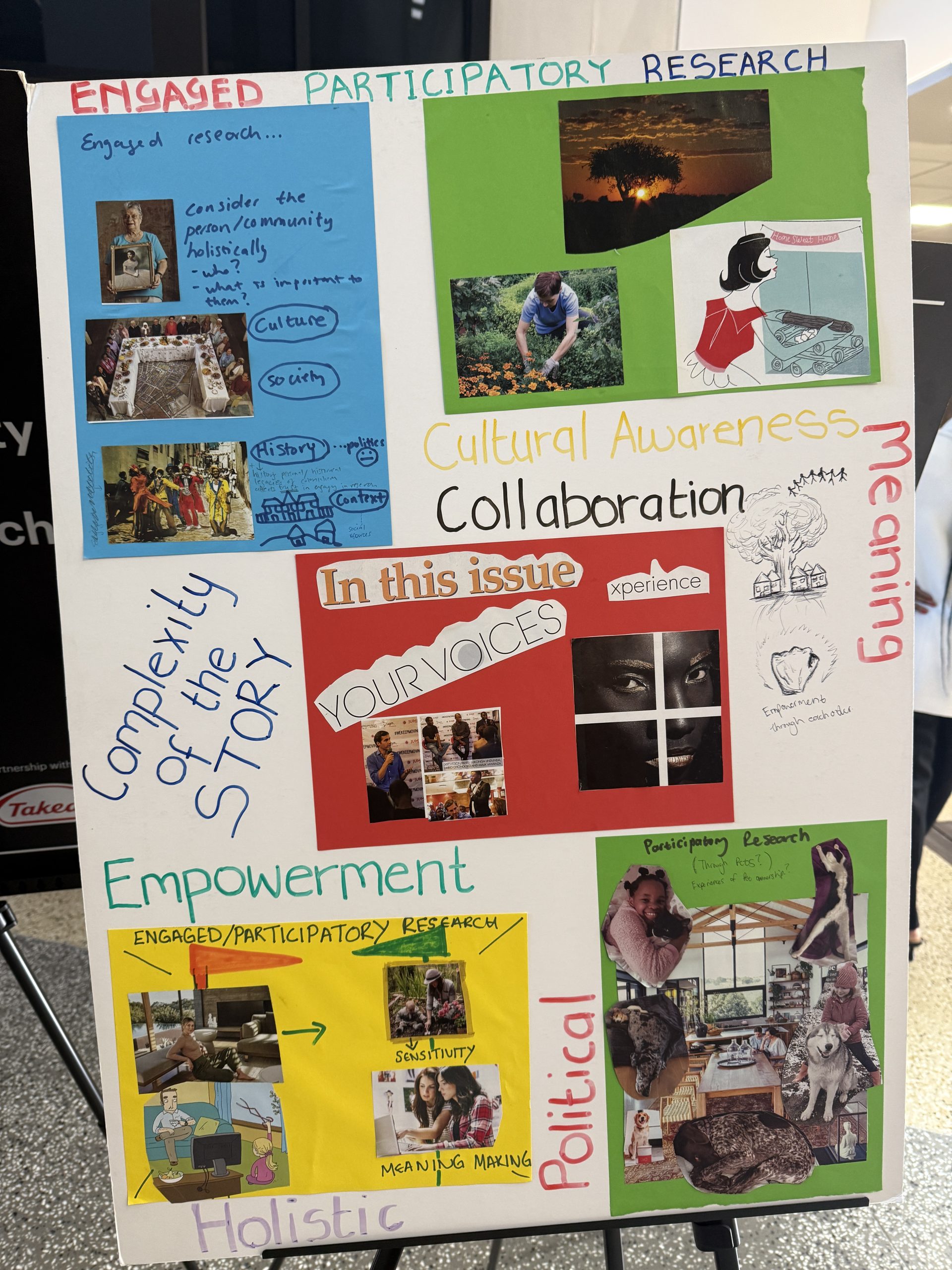 Interdisciplinary collaboration
What struck many of us was the diversity of backgrounds represented: educators, psychologists, artists, dancers, musicians, health professionals. This interdisciplinarity enriched the conversations and underlined the point that creativity is for everyone—not confined to the realm of art or therapy. This should not surprise us, as art is inherently interdisciplinary, drawing from multiple sources of knowledge and crossing the boundaries between disciplines to create a self-sufficient artwork.
While the criticality of interdisciplinary and transdisciplinary was repeatedly acknowledged, concerns were raised about the presence of adequate infrastructures available in universities and research organisations to nurture and promote such research. It was widely felt that despite calls for interdisciplinary research, systems continued to value and incentivise depth of knowledge over breadth of knowledge. This structural shortfall reinforces the hierarchies of knowledge that creative methods seek to challenge through privileging holistic understanding over specialized expertise, and the integrative knowledge over the measurable.
Building knowledge together
Perhaps the most compelling metaphor from the conference was that of walls and bricks. Traditional academic practices can feel like enclosing walls – ivory towers that restrict what counts as legitimate knowledge. But creative methods offer opportunities to reimagine knowledge-building differently: bricks laid collectively, creating structures that are more open, inclusive, and diverse. As one participant put it, “It’s about whose knowledge we value, and how we build together.”
Closing reflections
Walking away from the conferences, what lingers most is the sense of ongoing conversation and transformation.
Creative methods are not finished techniques but evolving practices, shaped in the moment, in relationships, and in reflection. Sometimes things don’t work. Sometimes there is no “data.” But even then, something happens: learning, exchange, recognition. In a world that often values speed and certainty, perhaps the greatest contribution of creative methods is to remind us of the value of slowness, openness, and imagination – everything that makes us ‘human’.
Engaging with creative methods offered us the opportunity to acquire depth in understanding concepts, not merely precision in defining them. We moved beyond generating external evidence to engaging in deep knowledge-making. This shift from researcher as detached analyst to researcher making sense through internal processing of phenomena we investigate changed how we see both our work and ourselves.