From local experiment to national movement: Majdal Anjar’s model for health governance in Lebanon
1 September 2025
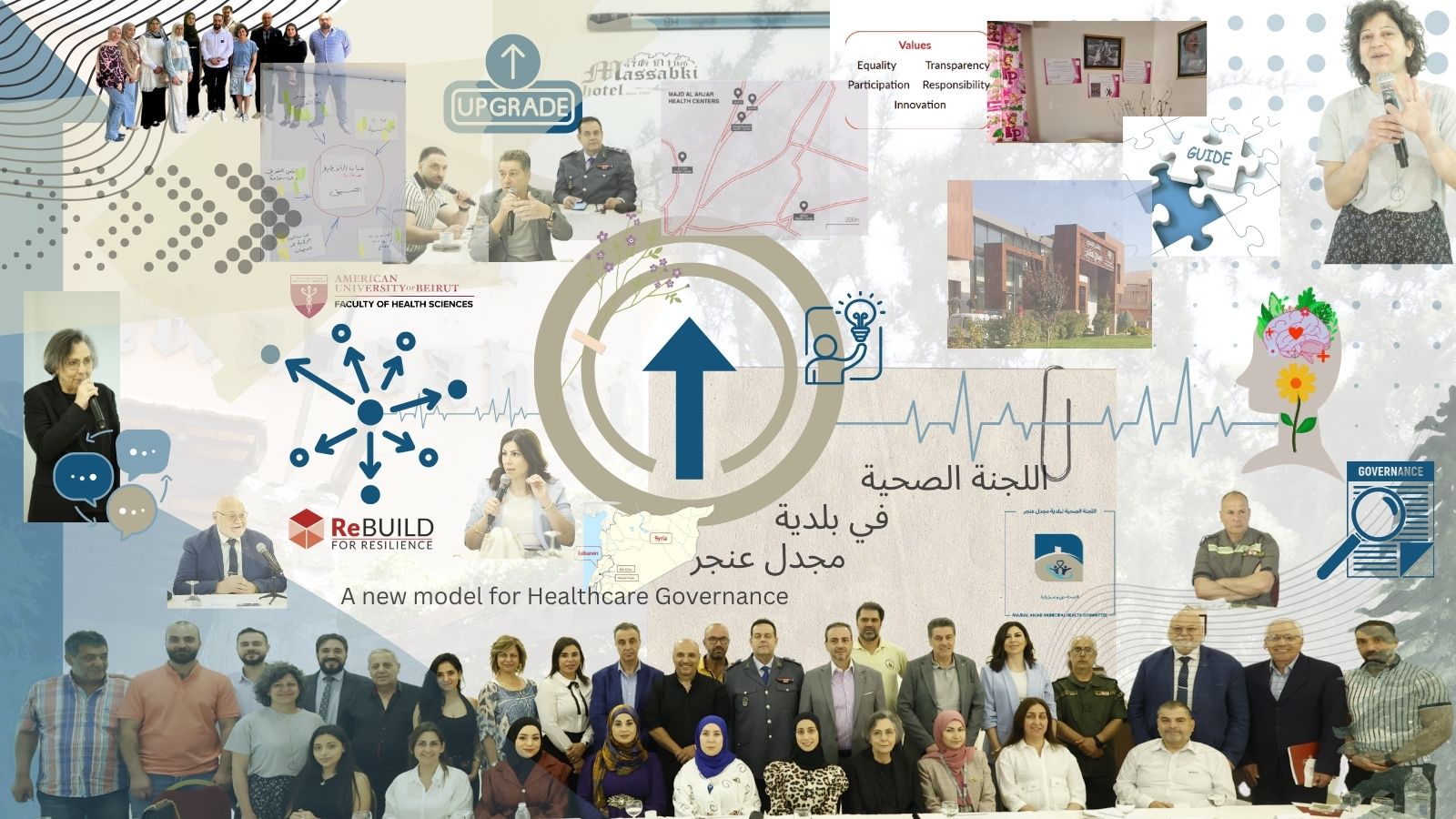
As part of the ReBUILD for Resilience project, the American University of Beirut (AUB) team hosted a dialogue meeting on May 24, 2025, at Massabki Hotel in Chtaura, Lebanon to showcase the Majdal Anjar Municipal Health Committee (MHC) as a model of local health governance. The meeting brought together the Ministry of Interior, the Ministry of Public Health (MoPH), municipalities across the Bekaa, UNHCR, civil society organizations, the Palestinian Red Crescent, and healthcare providers. What began as a case presentation quickly felt like a turning point.
There is more on the background to this meeting here.
A vision that resonates
Joanna Kahlil of AUB presented the MHC’s strategic plan, vision, mission, and values, which are anchored in four guiding principles:
• A community-driven approach: Committee members are local residents (both Syrian and Lebanese) with complementary skills (eg nurses, IT specialists), ready to volunteer time and energy and committed to the public good.
• Plans, not projects: Activities are captured in renewable annual plans that apply to all residents – regardless of nationality, status, or background.
• Closing the loop: A cycle of assessment, awareness, screening, referral, feedback, and tracking is integrated through a municipal health information system.
• Leadership, not service delivery: The MHC coordinates and regulates rather than directly providing services, relying on strong partnerships with local facilities and stakeholders.
The clarity of this vision and its grounding in inclusivity generated an unexpected wave of enthusiasm from those present in the meeting. The ReBUILD team was struck by the warm reception and genuine support; a moment of pride that confirmed how deeply this model responds to Lebanon’s urgent needs.
From plans to action
MHC coordinator Youssef Abdulkhalek outlined concrete initiatives that are already underway:
• Awareness of breastfeeding, child nutrition, and safe environments for children
• School health programs with annual medical visits
• Vaccination coverage assessments and follow-up for defaulters
• Better access to chronic medications through local coordination
• A virtual blood bank for urgent needs
• A community-tailored emergency plan anticipating regional displacement
Together, these actions show how municipalities can fill systemic gaps in a strained national system.
From model to movement
Momentum built quickly as participants voiced strong support for replicating the Majdal Anjar model across other municipalities.
The Mayor of Chtaura captured the need for practical tools:
“We need a guide on how to develop a health committee within the municipality.”
A MoPH representative highlighted the model’s strategic value in moments of national weakness:
“The MHC is a good local alternative when the MoPH faces periods of weakness. We cannot overlook these gaps.”
A Civil Defence representative stressed the importance of cross-sectoral coordination:
“There should be cooperation between the health committee and the environmental committee, as health and environment are interrelated.”
Other NGO leaders and healthcare professionals echoed the call for structure and strategy:
“Establishing a health committee within each municipality is an important step toward sustainable health governance.”
By the end of the meeting, four municipalities had expressed interest in creating their own committees, with three declaring readiness to begin immediately. The MoPH representative pledged to propose the idea in her own hometown and to personally lead its establishment, while a UNHCR representative signaled readiness to collaborate and approach the Municipality where she resides. A major charity envisioned establishing a similar body in Beirut around its three health centers, and the former Dean of the Faculty of Health Sciences at AUB announced his plan to found an MHC in his hometown in Metn District.
What began as a showcase of Majdal Anjar’s experience had, in just a few hours, transformed into a springboard for replication, adaptation, and collective ownership.
A call for guidance and support
In response to the call for a practical manual to guide municipalities and other bodies wishing to establish health committees, ReBUILD commissioned a consultant to prepare a first draft of a guide. This guide will be piloted, refined, and potentially adapted for use in other contexts – particularly in Syria, where such a model could prove valuable during the reconstruction phase.#
At the same time, the ReBUILD team and AUB’s Faculty of Health Sciences are working to establish a dedicated body for mentoring, training, and providing technical support. Hosted within the Faculty, this body would help municipalities build committees grounded in scientific evidence and good governance, while safeguarding them from clientelism and personal interests.
Looking ahead: Seize the moment
In a country marked by weak central stewardship, the Majdal Anjar experience shows that local health governance is both possible and necessary. MHCs can deliver equity, coordination, and accountability – the antidote to fragmentation and red tape.
Policymakers, donors, and partners: This is your cue!
• Back municipal health information systems and routine data use.
• Fund training and technical accompaniment for committees during their first 12–24 months.
• Align national frameworks to recognize and enable municipal leadership and cross-sector coordination.
With timely support, the Majdal Anjar model can move from promising pilot to national backbone – a community-led, resilient, and equitable health governance architecture for Lebanon.
Further information
There’s more on this study, including case studies, videos and articles, here.
The image at the top of the page is a collage created by the AUB team which shows the people involved in the process of creating the MHC, the group’s location, and a shot of the MHC members themselves. You’ll find other collages created by the team here.