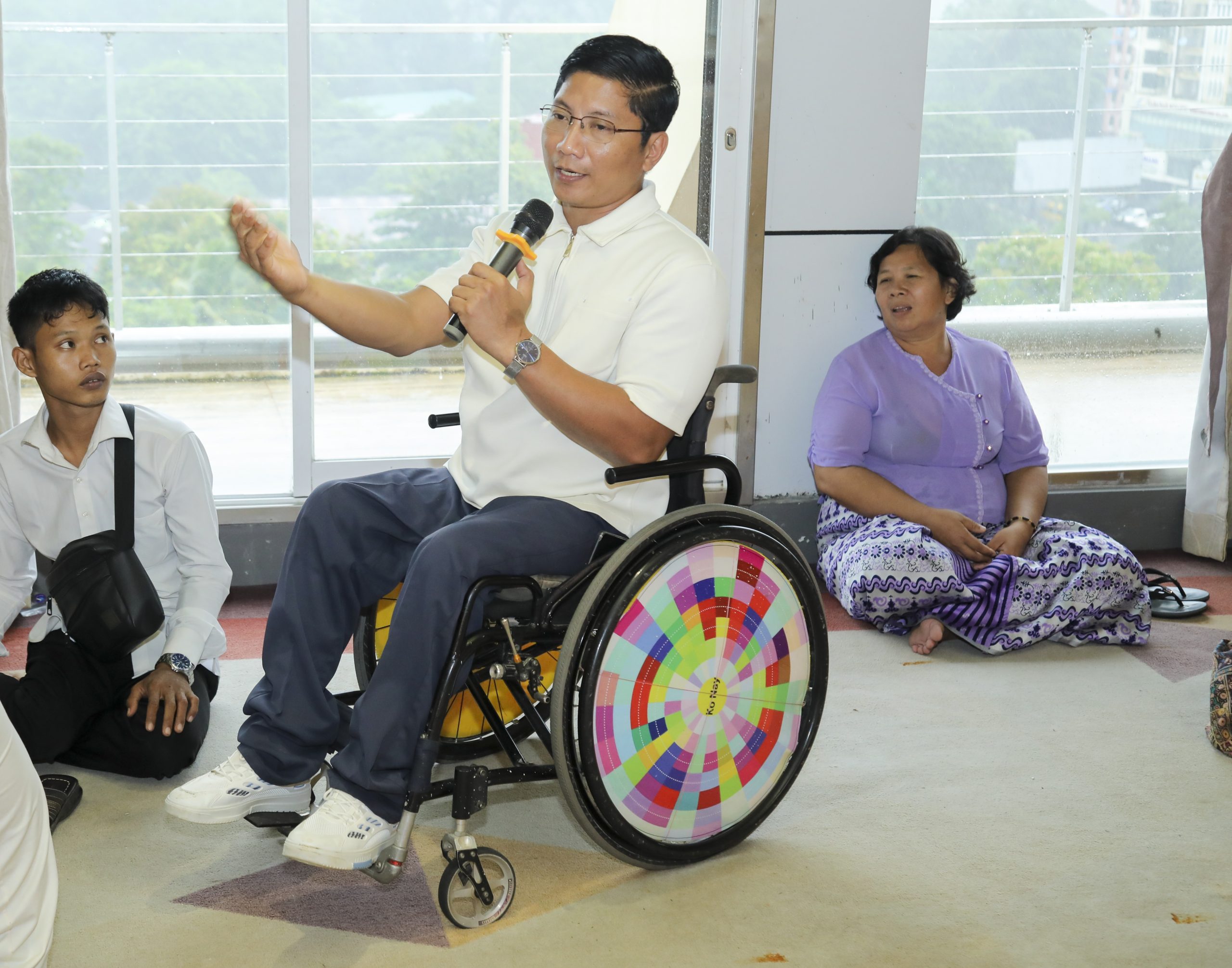
Promoting disability-inclusive leadership and gender equity in Myanmar: Challenges and opportunities
Background
Myanmar faces multiple, overlapping shocks, including conflict, natural disasters, economic instability, and displacement. In contexts like this, resilience-building efforts must prioritize inclusion to ensure that no one is left behind. Disability inclusion and gender equality are critical development issues in Myanmar. Many persons with disabilities face social stigma, limited access to services, and exclusion from decision-making processes. Cultural attitudes often view disability through a charity or medical lens rather than taking a rights-based approach.
Within the ReBUILD for Resilience Consortium, Burnet Myanmar has been implementing community-based, disability-inclusive health system building. This case study focuses on that process as well as Burnet Myanmar’s organizational capacity development.
What have we done?
Burnet Myanmar has been working in the township for nearly a decade, and realized that inclusion of disability in health programming was at a bare minimum. The team pioneered and co-designed a gender and disability-inclusive, community-based health project in one of the peri-urban townships. This project is not standalone; it was co-designed with other projects working in the township, such as the adolescent mental health project and SRHR projects funded by the Australian Government and Access to Health Multi-donor funding, respectively.
The coordination of health in the townships is managed through a township Coordination Committee mainly made up of non-state actors, including NGOs, INGOs and CSOs (civil society organizations). Although there was an organization for persons with disabilities in the township, there was low representation of persons with disabilities on the Coordination Committee, and what participation there was, was rather passive. There was limited awareness of gender and disability inclusive practices among Coordination Committee members and partners, and accessibility for persons with disabilities had not been systematically considered for services and activities. Women’s representation in the organization of persons with disabilities was also very low.
We used a two-pronged approach to inclusion: 1) building leadership capacity and 2) focusing on cross-cutting issues such as gender, equity and health concepts, targeting persons with disabilities and the organizations that represent them. Burnet Myanmar also organized training on disability inclusion concepts and awareness involving all health actors working in the township, to encourage mainstreaming of these issues.
As we co-designed the project in the township, we learned the following capabilities were essential in ensuring the township plan was inclusive.
Capacity development
We understood that researchers needed a greater understanding of disability concepts and how to incorporate disability into their working practices. Using the ReBUILD capacity building initiative, we were able to improve our own knowledge, awareness and practices of disability inclusion. We also used this mechanism to increase the capacity of the organization for persons with disabilities and other township volunteers and organizations. We mainly focused our capacity development on evidence-based, people-oriented organizational sustainability at the township level. As a result, one of our ReBUILD young researchers, Dr Thazin La, has gone on to take a leadership position in the Burnet Institute, Australia Gender, Equity, Diversity and Inclusion (GEDI) Committee.
Commitment
The Burnet Institute, Australia’s very first “Commitment to Action: Burnet Disability Action Plan (2024-2027)” was initiated. Mainstreaming and targeting were implemented in Myanmar through all programmes particularly targeting disability-aware organizational development and inclusive planning with all stakeholders in the township. Disability-related accountability mechanisms were also incorporated in the work of Burnet Myanmar in terms of inclusion frameworks and concepts.
Inclusive leadership and participation
We ensured the representation of persons with disabilities in all our projects and in the township Coordination Committee. We assisted persons with disabilities (including women) to take on leadership roles in the organization and established inclusion targets to guide participation. We not only gave leadership training to both women and men with disabilities but also helped them understand the ladders of participation (informing, consultation, placation, partnership, delegation of power and control). As the project gained momentum, they actively participated in the township Coordination Committee and were able to demonstrate their increased leadership capacity.
Culture of learning
Burnet Myanmar maintained the momentum of our learning culture by not only building staff and persons with disabilities’ knowledge and awareness of disability and gender inclusion, but also through a workplace disability audit assessment. This tested organizational capacity and reasonable accommodation structures.
Co-design
All the project activities and plans were co-designed using people-centred, disability-inclusion concepts. Persons with disabilities were actively involved from the beginning of the formative assessment to the action planning of its activities at the township level.
Communication
Burnet Myanmar was able to strengthen communications and collaboration skills of all stakeholders in the township Coordination Committee, and was able to assist in training, meetings and advocacy processes led by persons with disabilities and their organizations.
Impact
This case study highlights the importance of an intersectional approach to resilience. Disability, gender, poverty and displacement intersect to shape vulnerability and access to resources in Myanmar. Inclusive leadership plays a critical role in ensuring that resilience programming is responsive to diverse needs. When persons with disabilities and women are included in decision-making, interventions become more effective and equitable.
In the peri-urban township in Myanmar, the township health Coordinating Committee is now well versed in disability and gender inclusion concepts, and together with persons with disability has drawn a disability inclusive township coordinated action plan for the coming years, with practical measures ensuring no one is left behind.
However, challenges remain, including limited resources, security constraints, and deeply rooted social norms. Sustained commitment from organizations, communities and donors is required to address these barriers. Disability-inclusive leadership, combined with gender equity, is essential for effective resilience building in Myanmar. The ReBUILD for Resilience consortium’s experience demonstrates that inclusive approaches can empower marginalized groups, strengthen community resilience, and improve programme outcomes. Ensuring that persons with disabilities, especially women, are active participants and leaders in resilience efforts is not only a matter of rights, but also a practical strategy for achieving sustainable development.
Further information
Study: Including and engaging people with disabilities in research in Myanmar