Empowering female community health volunteers to address gendered challenges through a participatory community film in Nepal
Context
In Nepal, Female Community Health Volunteers (FCHVs), often act as the first point of contact between households and the formal health system. For decades, FCHVs have served as trusted community actors, supporting immunisation, maternal and child health, family planning, nutrition, and health promotion activities. Despite their long-standing contributions, many FCHVs work within constrained environments shaped by limited social recognition, competing domestic responsibilities, limited incentives, and embedded gender norms that undervalue women’s community leadership and voluntary work. These structural and gendered expectations influence FCHVs’ motivation and wellbeing, with important implications for the resilience of local health systems. To better understand and respond to these challenges, a Participatory Action Research (PAR) cycle was implemented, placing FCHVs at the centre of problem identification and the co-creation of solutions.
The challenge
HERD International held participatory discussions and interviews with FCHVs, community members, and local stakeholders which revealed a set of interconnected challenges affecting both FCHVs’ experiences and their relationships with communities. FCHVs described feeling undervalued despite their extensive contributions, noting that community members sometimes questioned and underestimated the scope of their responsibilities. Misbeliefs that FCHVs received substantial allowances created social tension and further undermined recognition of their voluntary work. FCHVs highlighted the challenge of balancing community duties with unpaid domestic responsibilities, including caregiving and household chores. Responding to the needs of the health system and community often required them to interrupt their family obligations. While many stakeholders acknowledged gender-related barriers, others minimised or denied these challenges. Such divergent perspectives reflect broader patterns of gender blindness within community settings at the local level.
Our approach
A PAR approach was used to address these challenges, engaging FCHVs in the co-creation of locally-tailored solutions. Through a series of participatory workshops and using problem tree analysis, FCHVs collectively discussed and identified the barriers affecting their work. These discussions enabled them to reflect on their lived experiences and explore the root causes of challenges including limited work recognition and the pressure of balancing the dual responsibilities of community and household activities. For many FCHVs, the workshops created a rare opportunity for collective reflection and open discussion of the challenges that were often normalised or overlooked. The process enabled them to articulate shared concerns and collectively identify the solution.
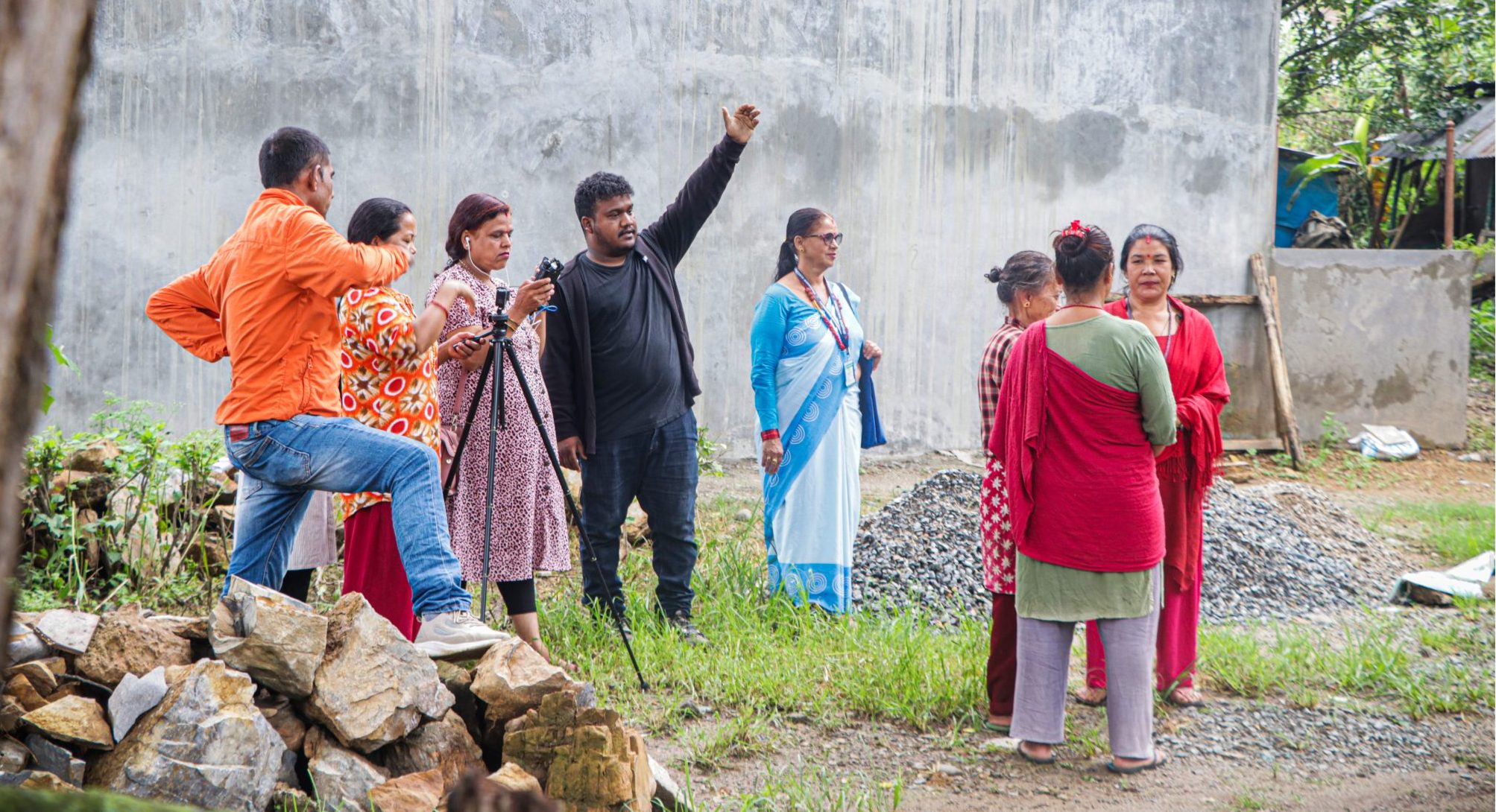
FCHVs proposed the creation of a community film to visually portray their work, address misconceptions, and create wider community understanding of their voluntary work and its impact at community level. With facilitation and technical support from HERD International, FCHVs actively engaged in all steps of the film-making process including script development based on their experiences, acting, using camera and sound recording equipment, and planning filming locations. The process emphasised collective learning, creativity, and shared ownership. Although many participants initially expressed fear about acting or using equipment, they described their growing confidence as the project progressed and they received support from the research teams.
Once finished, the co-created film was screened at showcasing events in the local community that brought together family and community members, health workers and local leaders. This was the FCHVs’ first experience of facilitating and hosting public events. These showcases created opportunities for dialogue and reflection on the realities of FCHVs’ work and the issues they face, including gendered challenges and the value of their contribution.
Outcomes
FCHVs described the film-making process as empowering and collaborative, noting that it increased their self-confidence, public speaking ability, and technical skills. A FCHV mentioned, “I used to be very scared of speaking in front of people previously, but now I can talk everywhere without fear.” They also described greater resilience in responding to criticism and negative comments. The film stimulated dialogue within households. Several FCHVs observed improved family awareness of their roles and responsibilities, contributing to greater emotional and practical support, including increased help from husbands in managing the household chores. In some cases, family members expressed appreciation after seeing the portrayal of FCHVs’ daily challenges, which improved understanding of their work. The film helped shift family and community members’ perceptions by enhancing understanding of FCHV responsibilities, including the pressures they face in balancing domestic and community roles, correcting misconceptions about allowances, and fostering appreciation of their unpaid contributions. Another FCHV shared, “After watching the film, family members have become more understanding in terms of dual responsibility, and now it has become easier to go to work.”
Local community and health stakeholders reflected that the film changed how they viewed FCHVs’ abilities and potential for skill development when given opportunities. They valued how the film visualized their lived realities. A stakeholder noted, “People may forget what they hear, but when they watch, they never forget, so it is a good way to convey messages. I think the video has presented the truth of FCHVs’ realities.” The film served as a powerful tool to make visible the often overlooked work and contributions of FCHVs, while also stimulating discussion on women’s unpaid care burden and the gender norms shaping their volunteer work in Nepal.
Further information
Blog post: A rollercoaster ride of film making for female community health volunteers
Film: A Story of Female Community Health Volunteers
More on this study: Close-to-community providers addressing gender norms and power dynamics: participatory action research in fragile and shock-prone settings
There are other ReBUILD for Resilience case studies here
Image: HERD International staff working with the female community health volunteers