Instilling the value of inclusive governance – case study
Background
The ReBUILD for Resilience team at American University of Beirut (AUB) partnered with local stakeholders and non-state healthcare actors at our learning site in Majdal Anjar in the Beqaa Valley of Lebanon to form a learning site team (LST). The LST collaborated with an official body – the Majdal Anjar Municipality Board – to establish the Majdal Anjar Municipal Health Committee (MHC). The MHC implemented a model for decentralized healthcare governance, aimed at enabling the Municipality to take charge of their local health provision.
The Municipality Boards are the local political authority in any village or neighborhood in Lebanon and are supposed to help meet the needs of their communities, regardless of their grouping or political affiliations. The Boards should provide social services, invest local taxes in development projects, and improve the social status of the local communities through a process of participatory governance (see Salem et al, 1998 – opens new tab). In reality, Municipalities Boards have become vehicles for political influence, echoing Lebanon’s wider political scene. Like the political parties of central government, they often practice clientelism, are fragmented in their actions, and support the interests of their political sponsors. The Municipality Boards are required by law to be made up of representatives from the local communities, but this is often not the case. No needs assessments are conducted to help form the visions and action plans for their areas, and instead the Boards serve the directives of the Ministry of Interior and of Municipalities (MOIM) and the demands of the political parties who in turn support the Municipality Boards (see Cheikh Ali, 2013 – opens new tab). The only domain where the Boards are fulfilling their mandates is in granting construction permits, and delivering a few public works, often before seeking re-election. But even this has slowed due to a dramatic drop in Municipal revenues, owing to defaults in the payment of local taxes and the devaluation of the national currency.
The problem
Municipalities are looking for alternative revenues, through donations and participation in lucrative social programs. In regions with high vulnerabilities, mainly owing to the presence of refugees and the impoverishment of the host populations, municipalities are in the position of authorizing and supervising programs funded by external bodies, and use this privilege to reinforce local power structures. The Municipality of Majdal Anjar was no exception; the elected Municipality Board was dominated by the two families who had ruled the village since Ottoman times. They saw their participation in the MHC as an opportunity to gain more power, without ensuring the relevance, impact or sustainability of the funded programs.
The early days of the LST’s work with the MHC met with complications. The team met with members of the Board who had been selected by the Mayor, and it soon became apparent that there were very different mindsets between the “political” members of the committee, represented by Municipality Board members, and the “technical” team, who were LST local partners and who had already been briefed on the importance of equity, inclusive governance, participation and transparency.
The MHC had collectively opted for an ambitious vision and mission, and was supposed to apply values of transparency, equality, responsibility and participation to their activities, working towards equitable access to healthcare services. However, in practice, not all MHC members were responsive to the values they had collectively developed. Those representing the Municipal Board were engaged in implicit, and sometimes overt, competition with each other, scrutinizing and criticizing each other’s actions.
Also, members of the Municipal Board considered leadership of health programs and projects as an expression of personal power, rather than the opportunity to participate in a collective effort. Those Board members seemed reluctant to work as a team or to accept collective decision making and transparency. They wanted to deal with those they perceived as “equals” in terms of social power and influence, and while they valued the AUB team, probably for the “prestige” an academic institution can bring to the project, they looked suspiciously towards the members of the MHC who came with the LST team, especially the Syrian members.
A highly negative perception of Syrians was dominant in the country at both popular and official levels (see Hamadeh et al, 2021 – opens new tab), and Syrian refugees were considered a hinderance rather than an opportunity (see Ammar et al, 2016 – opens new tab). This was seen in the Board members’ attitudes to the Syrian members of the MHC. In MHC meetings, phrases such as “Syrians are getting all the support, everything is for Syrians, we need to secure support for the Lebanese who are impoverished” were frequently heard, and there was repeated reluctance to agree that Syrian refugees should be included in any program under discussion. This was despite the Syrian refugee community having been in the country and their neighbors for more than 10 years.
When the members of the Municipal Board first joined the workshop that launched the MHC, they discovered two Syrian doctors – Fadi El Halabi and Mohamad Meibar – among the LST. The members’ body language expressed their deep reluctance to deal with the two Syrians, and the two doctors were granted far less attention and treated with less credibility than their Lebanese colleagues. Later, Dr Fadi received a voice message from a member of MHC and Municipal Board, telling him that he could not act on behalf of the MHC (to initiate a partnership and data sharing with the health facilities in Majdal Anjar), because he was not a member of the Municipality Board. He was effectively told that he is not an influential person in Majdal Anjar and could not represent the Municipality. In actual fact, the MHC had previously allocated tasks to members who were not part of the Municipal Board. It was obvious that there was reluctance to allow Syrians to represent the Municipality.
Changing mindsets and practice
We approached the problem of marginalization and exclusion from several angles:
Reinforcing values of equity and inclusion
The AUB team took every opportunity to insist that the MHC acted on the principles of decentralized governance – accepting responsibility for the entire population, whoever they are – in order to break those prejudices, and instil the concepts of equity. They described the Municipality’s previous model of segregated governance, which provided services to sub-populations based on nationality and social class (and which had been adopted by the MoPH, among others), as being unworkable if they were to develop services for the good of the whole community. The AUB team also highlighted the need to operate at the community level, and to include representatives of all subcommunities in their governance structures.
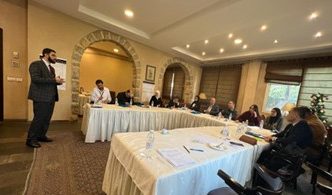
Dr Fadi leading a discussion in a MHC workshop
Fortitude and patience
Drs Fadi and Mohamad both showed exceptional tolerance of the slights directed at them. Both men showed real fortitude, drawing on previous experiences of dealing with Lebanese officials. Rather than react to harsh words and adopt a defensive stance, they remained dedicated to the initiative and their roles.
Compromise
Collective decision making requires compromise, and some concessions were made, albeit with reluctance. For example, we agreed that Dr Fadi be accompanied by a member of the Municipality Board on his visits to the health centers, navigating the conflicting positions of the MHC, and working towards a future mutual trust.
Relevant experience and skills
We gave certain appropriate tasks to Drs Fadi and Mohamad, who are in senior positions in Ghrass el Kheir, the informal health center attended by most residents of Majdal Anjar. Both men demonstrate high organizational capacities in their work, have valuable experience in dealing with health programmes, and possess the required knowledge – both hold master’s degrees from AUB. The shift in attitudes among the political appointees on the MHC, from skeptical to collaborative, started to appear at this point, when the value of having technically strong people within the MHC became obvious.
Role models
Both Syrian doctors demonstrated humility and dedication, putting efforts into collective work and not seeking recognition, even when they had accomplished important tasks. The doctors generously proposed extending the programmes they were running in their health center to the entire population, putting them under the supervision of the MHC. By behaving as full members of the team, they provided an example to others and demonstrated that inclusivity can only improve the MHC’s performance and enrich the members’ shared experience.
Result
The two doctors became full members of the MHC, sitting at the same table as the people who had been resistant to their inclusion. There they discuss decisions touching the entire community, and are seen as part of the solution, not part of the problem – a major shift for local governance. Even so, it came as a surprise when elections for the MHC administrative board saw Dr Fadi proposed as vice-president, without opposition or discussion, let alone negative body language or harsh words, demonstrating a real shift in attitudes.
This result was appreciated by the doctors themselves. In an email to the AUB team they wrote:
“We appreciate the opportunity to express our thoughts on the case study. The challenges and experiences outlined in the case study resonate with us, as we have faced marginalization and prejudice in our work. We are grateful for the support and advocacy provided by the AUB team guided by ReBUILD for Resilience colleagues, which has helped in promoting inclusivity within the Municipal Health Committee in Majdal Anjar.
Despite the initial resistance and scepticism towards our presence in the MHC, we are proud to have been able to contribute our expertise and experience to the betterment of the community. Our dedication to public health and our belief in the principles of equity, accessibility, and inclusiveness have allowed us to actively participate in the MHC and make a positive impact.
It is encouraging to see that, over time, the mindset of the MHC members has shifted, and the value of our contributions has been recognized. The fact that Dr. Fadi was proposed as the Vice-president of the MHC without any opposition is an important milestone in fostering inclusivity and breaking down barriers.
As Syrian doctors working in Lebanon, we understand the importance of overcoming prejudices and working together for the well-being of all members of the community, regardless of their nationality or background.
We are committed to continuing our work with the MHC and collaborating with all stakeholders to ensure that healthcare services are accessible, equitable, and inclusive for everyone.
We believe that, by working together and embracing the principles of equity, accessibility, and inclusiveness, we can create a more just and resilient healthcare system for all.
Fadi El Halabi and Mohamad Meibar”
Further information
More on the Majdal Anjar learning site project and related outputs can be found here.
There are other ReBUILD for Resilience case studies here
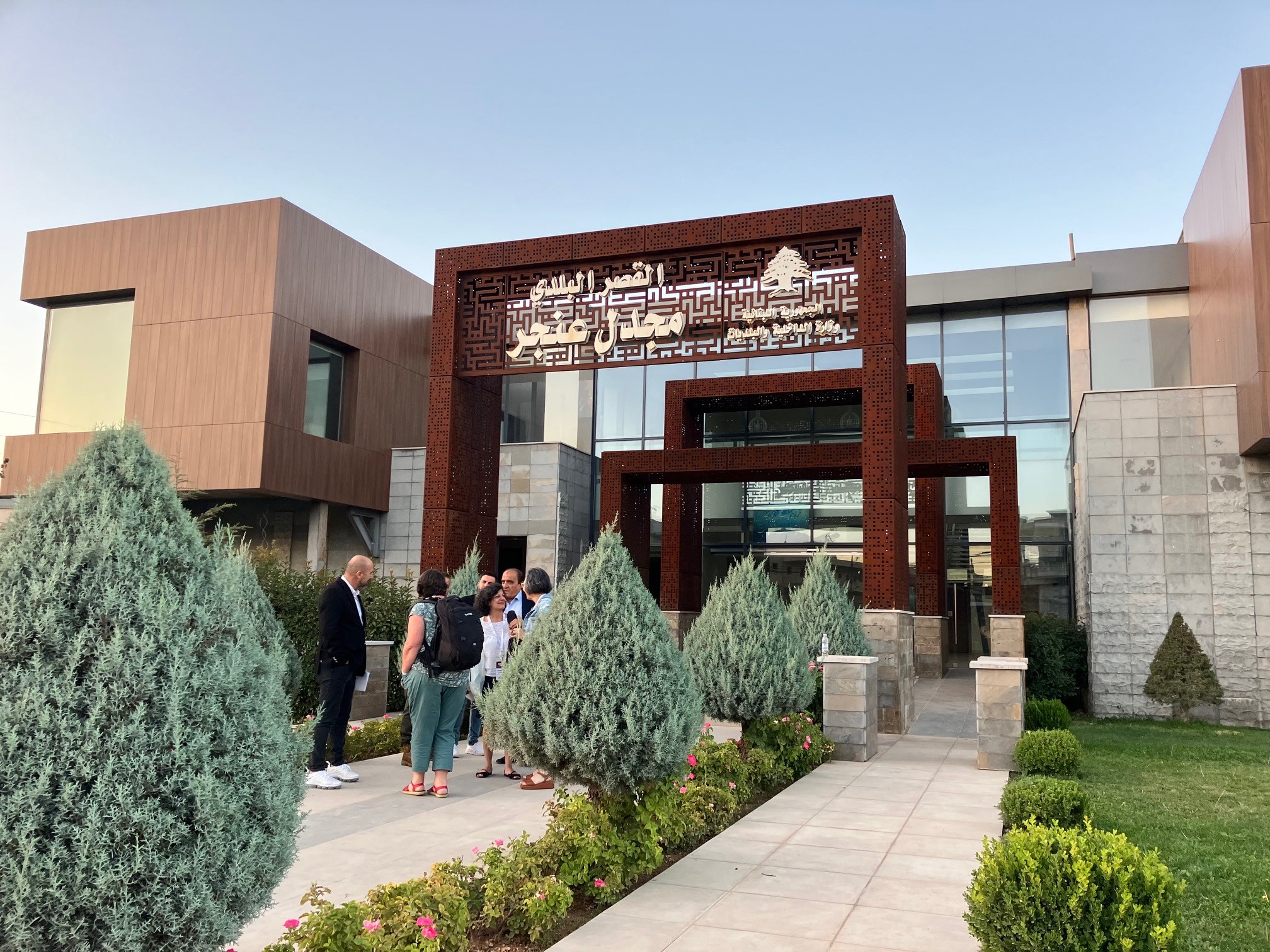
Main image: Members of the MHC and ReBUILD team outside the Majdal Anjar municipality building