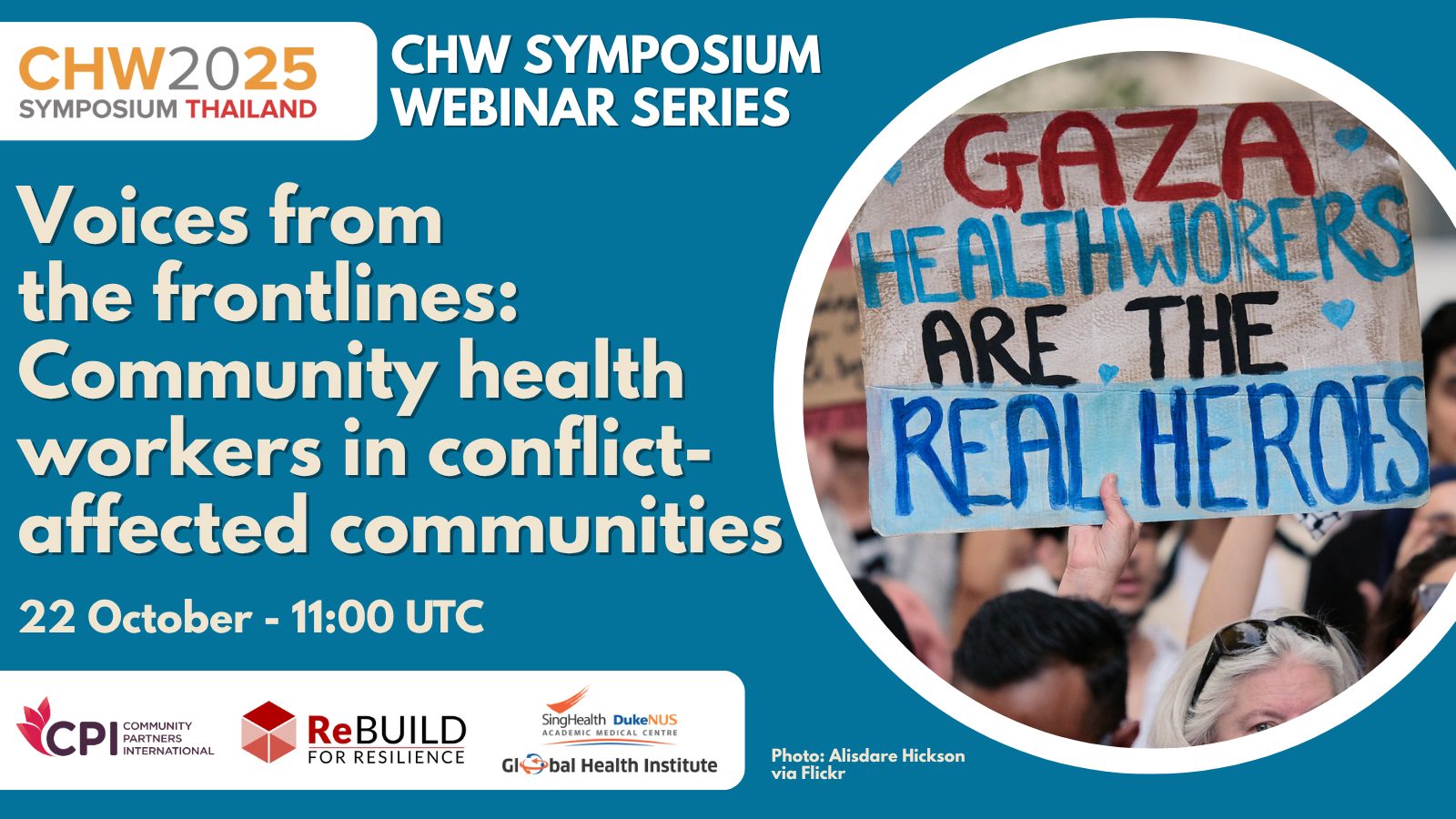
Image courtesy of Alisdare Hickson via Flickr.
Webinar – Voices from the frontlines: Community health workers in conflict-affected communities
9 October 2025
The webinar has taken place. Watch the recording here.
November will see the Community Health Workers Symposium 2025 (more on that here – opens new tab). In the run up to the symposium, Community Partners International [opens new tab], in partnership with ReBUILD for Resilience and SingHealth Duke-NUS Global Health Institute, is presenting a webinar series about community health workers (CHWs). There are five webinars in the series with topics including gender, conflict, research, climate change and sustainable financing (see below). ReBUILD is leading on the CHWs and conflict session.
Speakers
Amuda Baba, Director General at Institut Panafricain de Santé Communautaire et Medecine Tropicale University College, Ituri District, in north east Democratic Republic of the Congo.
Amuda has extensive experience in the field of community health, including in the impact of conflict on health workers and community-based interventions in fragile and rural settings in DRC. He will present CHWs in conflict-affected settings. Experiences and challenges of CHWs working in fragile and conflict-affected Ituri Province.
Amuda is also a senior lecturer in the field of public health at Bunia Nursing College.
Malak, Community Health Worker, Lebanon
Malak is a Syrian CHW living and working informally in Lebanon. She will talk about her experiences as a health worker, serving her local refugee community while juggling family responsibilities, all at a time of crisis for both Syria and Lebanon.
Joanna Khalil, Research Fellow at American University of Beirut, Lebanon.
Joanna is part of ReBUILD’s research team in Lebanon where she has worked with female Syrian close-to-community health workers in informal settings in Beqaa Valley. She will present Holding the system together: Women health workers and collective care in crisis-hit Lebanon.
Joanna will describe ReBUILD’s participatory action research with the health workers, revealing how marginalised women health workers transformed from passive recipients of programmes into organised agents of change. She will trace the formation of the Working Women Support Group, a collective born amid Lebanon’s overlapping crises, to illustrate how solidarity, skill-building, and advocacy can strengthen both personal resilience and local health systems. Through collaboration with local NGOs, these women advanced initiatives in childcare, community cohesion, and advocacy, showing how grassroots empowerment links social support to systemic health resilience.
Paolo Malerba and Alessandro Lamberti, EMERGENCY, Italy [opens new tab].
EMERGENCY is an independent, neutral organisation which provides free, high-quality medical and surgical care to victims of war, landmines and poverty. For this webinar, Paolo Malerba [opens new tab] will present Strengthening Primary Care in War-Affected Donetsk: A Community-Based CHW Model which will look at disease burden, access barriers, and practical challenges in that region of Ukraine. Alessandro Lamberti [opens new tab] will be available to answer questions in the Q&A session after the presentations.
Since 2022, EMERGENCY NGO has been working on a community-based primary care network in Kramatorsk raion, Donetsk Oblast (Kramatorsk raion). The project rehabilitates and equips clinics (including prefab units) and trains and deploys CHWs for door-to-door outreach, medication support, and health education. It currently comprises 11 CHWs and 14 clinics serving 14 villages (~10,000 people). Over the past two years, CHWs have delivered more than 9,000 home visits, strengthening access and continuity of care for vulnerable households despite ongoing hostilities and mobility constraints.
Mejd Azzeh, Director of 1for3 in Palestine [opens new tab]
1for3 works with, and provides services to, Palestinian refugees living in UN-run camps in the West Bank. Mejd will present Frontline Care and Community Strength: Health 4 Palestine’s CHWs in Refugee Camps. She will highlight the evolution of the project’s work since 2017, focusing on the vital role of CHWs in UN-run refugee camps across the West Bank, particularly Tulkarm Camp, who have delivered consistent, compassionate care amid displacement, insecurity, and trauma. Their experiences reveal how locally rooted, trauma-informed care can sustain hope, strengthen resilience, and bridge critical gaps in a fractured health system.
Kyu Kyu Than, Research Director at Burnet Institute Myanmar.
Kyu Kyu leads the ReBUILD team in Myanmar and has extensive experience in health systems research, with a particular focus on sexual, reproductive and maternal health. She will chair the session.
The webinar has taken place. Watch the recording here.
Background
Community Health Workers (CHWs) are essential health providers in many of the world’s most fragile and conflict-affected settings. From protracted humanitarian crises to sudden-onset emergencies, CHWs often represent the only accessible source of health care for populations caught up in the trauma. Their presence in communities before, during, and after conflict makes them uniquely positioned to provide continuity of care, deliver lifesaving services, and support recovery.
Yet, the role of CHWs in conflict-affected contexts is often under-recognised and under-supported. Operating in environments of insecurity, displacement, and fractured health systems, CHWs face immense personal and professional challenges, including threats to their safety, limited access to supplies, disrupted supervision structures, and lack of remuneration. Many are also from communities directly affected by violence, adding emotional and psychological burdens to their already demanding roles.
This webinar will spotlight the lived experiences of CHWs working in conflict-affected settings. It will explore the practical, emotional, and ethical dimensions of frontline health work in crisis zones, while also highlighting promising strategies to support, retain, and protect CHWs in such contexts. By elevating their voices and perspectives, the session aims to shape more equitable, resilient, and responsive health systems in fragile settings.
Further information
Lots more on ReBUILD’s work with community health workers here.
There are recordings of the previous webinars in this series here:
- Gender Transformative Programming: CHWs as Agents of Social Change
- Nothing About Us Without Us: Centering CHWs in Health Research [opens a new tab]
- The Role of Global Health Actors in Supporting Sustainable CHW Financing [opens a new tab]
- Frontline Resilience: How CHWs Are Responding to the Health Impacts of Climate Change [opens a new tab]
Image: ‘Gaza health workers are the real heroes’, Alisdare Hickson via Flickr [opens new tab]