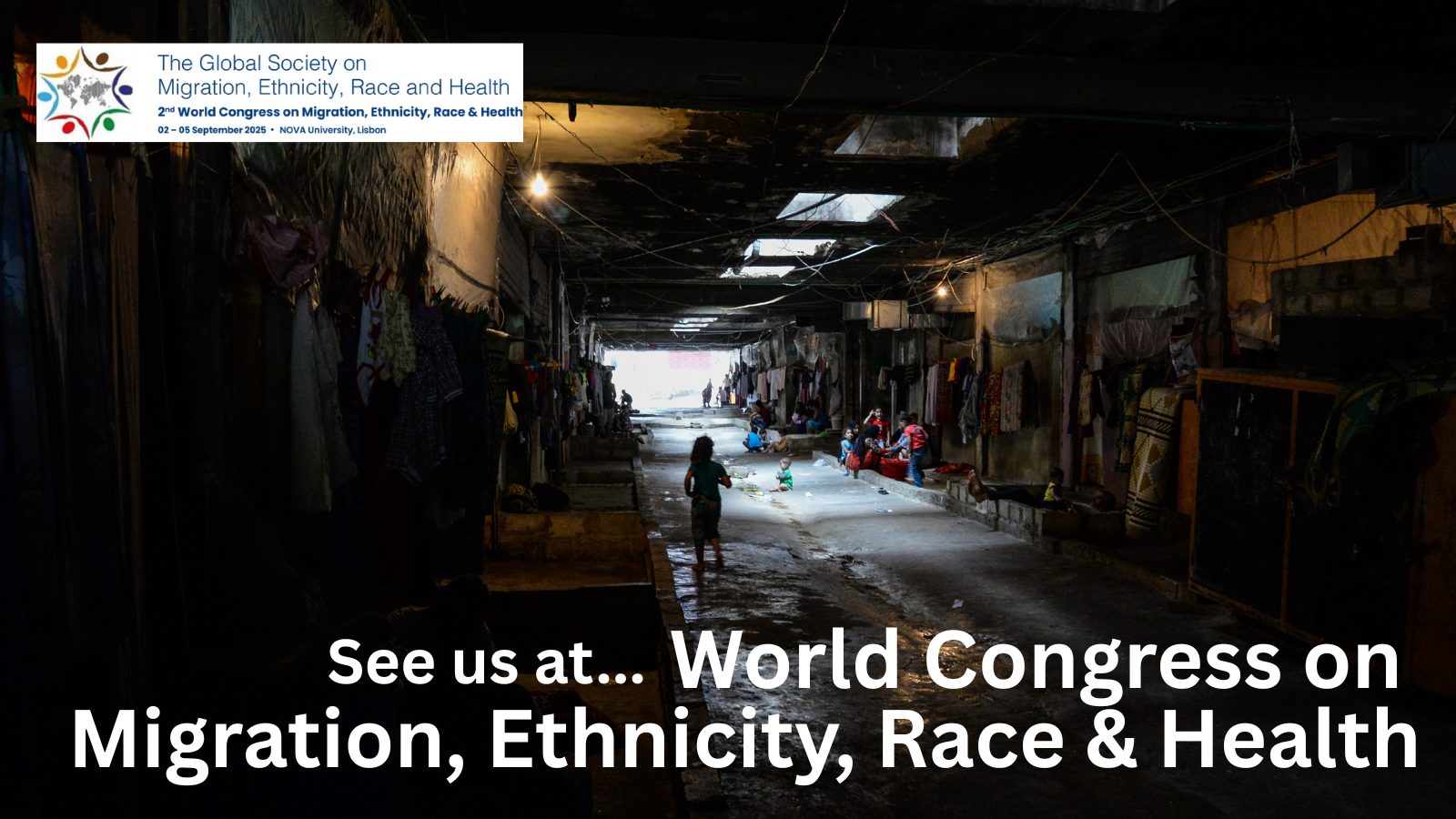
Refugees living in an abandoned factory near Saida, Lebanon. Anthony Gale via Flickr. Attribution-ShareAlike 2.0 Generic (CC BY-SA 2.0)
ReBUILD at Second World Congress on Migration, Ethnicity, Race and Health
1 August 2025
This event has taken place. Recordings of some of the sessions will be available soon.
Cross-border health systems, health financing, humanitarian assistance and climate resilience are just some of the topics being presented by the ReBUILD for Resilience team at the Second World Congress on Migration, Ethnicity, Race and Health [opens new tab]. If you are at Universidade NOVA de Lisboa on 2-5 September we would love to see you at one of our presentations, our exhibition stand or at our lunchtime event.
Please note that all times are local time (UTC +1)
Lunchtime event – Healthworkers: a film
Thursday 4 September, 12-12.45pm – Main lecture hall in the Rectory
Grab your lunch and then pop into our special session – Healthworkers: a film. In this lunchtime event we will show a short film about female Syrian refugee health workers in Lebanon. Professor Fouad Fouad of LSTM will be interviewing the ReBUILD commissioners of the film (Rouham Yamout and Joanna Khalil from American University of Beirut). They will discuss its purpose and impact on the women involved, and consider the importance of film as a health communication tool. You will also have the opportunity to ask questions about the film and the migrant health workers featured.
ReBUILD in the exhibition space
ReBUILD will have a display in the Rectory where you can pick up copies of our migration-related papers, case studies and briefs, watch a short film, and chat to the ReBUILD team at the conference.
While there you should also check out Thazin La’s poster – Approaching data collection in a liminal health system: Engaging migrants and internally displaced communities along the Thailand–Myanmar Border. She’ll be presenting at 11:40am on Thursday at e-Poster Terminal 2.
ReBUILD presentations
Wednesday 3rd September
The role of health service providers in health system resilience amidst Lebanon’s multi-crisis situation
3:15-3:27pm – OP 8: Health Services 6 – B304 (FCSH)
Rouham Yamout
This oral presentation explores how healthcare providers in Lebanon, at both individual and institutional levels and in the formal and informal sectors, navigate the profound challenges which have recently beset the country. We explore the challenges to sustain service delivery, and at whose expense, with a focus on the local response in crisis-affected regions.
Health workforce response to the 2023 earthquake in non-state Northwest Syria: Cross-border challenges and lessons for future emergency preparedness
3:45-3:57pm – OP 6: Health Policy 2 – B308 (FCSH)
Wesam Mansour
The 2023 earthquake in northwest Syria worsened the vulnerabilities of a health system already weakened by conflict, displacement, and resource shortages. The crisis affected local populations and Syrian refugees in Türkiye, as health workers and humanitarian organizations faced legal restrictions, border closures, and fragmented aid distribution. This study examines the health workforce response in Syria, focusing on cross-border service provision, coordination mechanisms, and workforce adaptations to inform future emergency preparedness.
Also on Wednesday, ReBUILD’s Ibrahim Bou-Orm is speaking at the Lancet Commission workshop – Transforming the humanitarian system to respond to the needs of forcibly displaced populations.
5-6pm – WKS 10 – B309 (FCSH)
Thursday 4th September
Integrating refugees into inclusive health financing systems
1:30-2:30pm – WKS 15 – B305 (FCSH)
In this workshop, Sophie Witter and colleagues focus on the issue of integrating refugees into health services. While essential, to date this has overlooked important technical and political considerations in the field of health financing. The workshop will (a) strengthen the competency of participants in understanding opportunities and challenges of refugee health financing integration and (b) identify areas for future research. The seminar format will establish shared conceptual frameworks and examples from the field to structure a discussion with participants. The session will build on a WHO Global evidence review on health and migration (GEHM) report (in press) and the presenters’ ongoing research in this field.
Towards a climate-resilient and inclusive health system: Policy context and climate actions at subnational level in Nepal
2:57-3:09pm – OP 24: Refugees and Asylum Seekers 2 – B210 (FCSH)
Sushil Baral
Nepal ranks as one of the most vulnerable countries to climate change, facing extreme weather events and health risks. Limited evidence exists on the understanding and capacity of local health systems regarding climate change and health. This oral presentation reviews current policies, explores stakeholders’ and community members’ understanding of the crisis, and assesses the preparedness of local health systems to address climate change-related health risks.
Fostering inclusive health governance: Overcoming barriers to refugee inclusion in local decision-making
3:09-3:21pm – OP 25: Exclusion and Discrimination 3 -B207 (FCSH)
Joanna Khalil
Lebanon has faced escalating crises due to decades of sectarian-driven governance, corruption and clientelism. The influx of Syrian refugees since 2011, the economic collapse starting in 2019, the COVID-19 pandemic and the attacks on Lebanon in 2024 severely strained governance, particularly in healthcare. ReBUILD for Resilience’s Lebanon partners at American University of Beirut partnered with local stakeholders in Majdal Anjar to establish a Municipal Health Committee, a decentralised governance model aimed at improving local healthcare oversight. However, the initiative faced challenges due to entrenched political dynamics and resistance to inclusive governance, particularly regarding the participation of Syrian healthcare professionals. In this oral presentation we examine the barriers to equitable governance and the strategies used to foster inclusion within the Municipal Health Committee.
Health without borders: Rethinking cross-border health systems for migrants and displaced communities
4-5pm – WKS 24 – B203 (FCSH)
State-centric health systems inherently fail vulnerable populations such as displaced people living in or across border regions, or those trapped between power borders. These systems, designed around national sovereignty and territorial governance, often neglect the transnational realities of migration, conflict, and displacement. As a result, millions of displaced populations in borderlands from Myanmar to Syria and the Mexico-Guatemala corridor remain caught in limbo, navigating complex humanitarian and political landscapes with limited access to essential health services. This roundtable will critically examine the conceptualization and practicality of cross-border health systems as an alternative to top-down, state-centric models.
The session features:
- Ibrahim Bou-Orm, Liverpool School of Tropical Medicine & ReBUILD
- Kyu Kyu Than, Burnet Institute Myanmar & ReBUILD
- Maria Bertone, Queen Margaret University, Edinburgh & ReBUILD
- Cesar Rodriguez, Border Humanitarian Health Initiative
- Fouad Fouad, Liverpool School of Tropical Medicine & ReBUILD
Empowering refugee female healthcare workers: A community-driven approach to advancing equity and inclusion
4:36-4:48pm – OP 27: Refugees and Asylum Seekers 3 – B210 (FCSH)
Rouham Yamout
Lebanon’s healthcare system is in crisis, disproportionately affecting informal healthcare workers and particularly refugee women who have joined the health workforce during the country’s polycrisis. These women play a crucial role in delivering essential health services within refugee communities but face systemic barriers, including gender discrimination, economic precarity, and exclusion from formal labour protections. This oral presentation examines a grassroots initiative advocating for the rights and well-being of female refugee informal health workers, promoting equity to reach a more just health system while enhancing their resilience and social cohesion.
A film about some of these women and the dual burden they endure (home and work) will be showcased at our lunchtime session on Thursday 4 September (see above).
Strengthening healthcare governance: Effective leadership and equitable strategies for universal health coverage through the Municipal Health Committee in Majdal Anjar, Lebanon
5:18-5:24pm – PTH 6: Health Policy and Health Services 1 – B307 (FCSH)
Joanna Khalil
Lebanon’s healthcare system has been severely impacted by multiple crises, including economic collapse, political instability, COVID-19, and regional conflicts. The resulting fragmentation and privatisation have weakened service delivery, resulting in shortages of medical supplies, increased out-of-pocket expenses, and reduced access to care for both refugees and host communities. In response, the ReBUILD for Resilience Lebanon team implemented participatory action research in Majdal Anjar, leading to the establishment of the Municipal Health Committee. This initiative aimed to enhance local healthcare governance through evidence-based management, inclusivity, efficiency, and equitable access to quality healthcare. This pitch presentation examines the committee’s development, priorities and impact.
Friday 5th September
Strengthening health system financing in complex humanitarian contexts: analysis from Northwest Syria and its implications for other disrupted contexts
11:30-11:36am – PTH 8 – B304 (FCSH)
Ibrahim Bou-Orm
In Northwest Syria, successive periods of protracted war and forced displacement have led to shifting, fragile, and donor-dependent health systems. Our study aims to contribute to actionable evidence on the optimal use of scarce financial resources to reduce fragmentation, increase resilience, and build sustainability in the context of Northwest Syria and similar areas which lack strong governance and/or state presence.