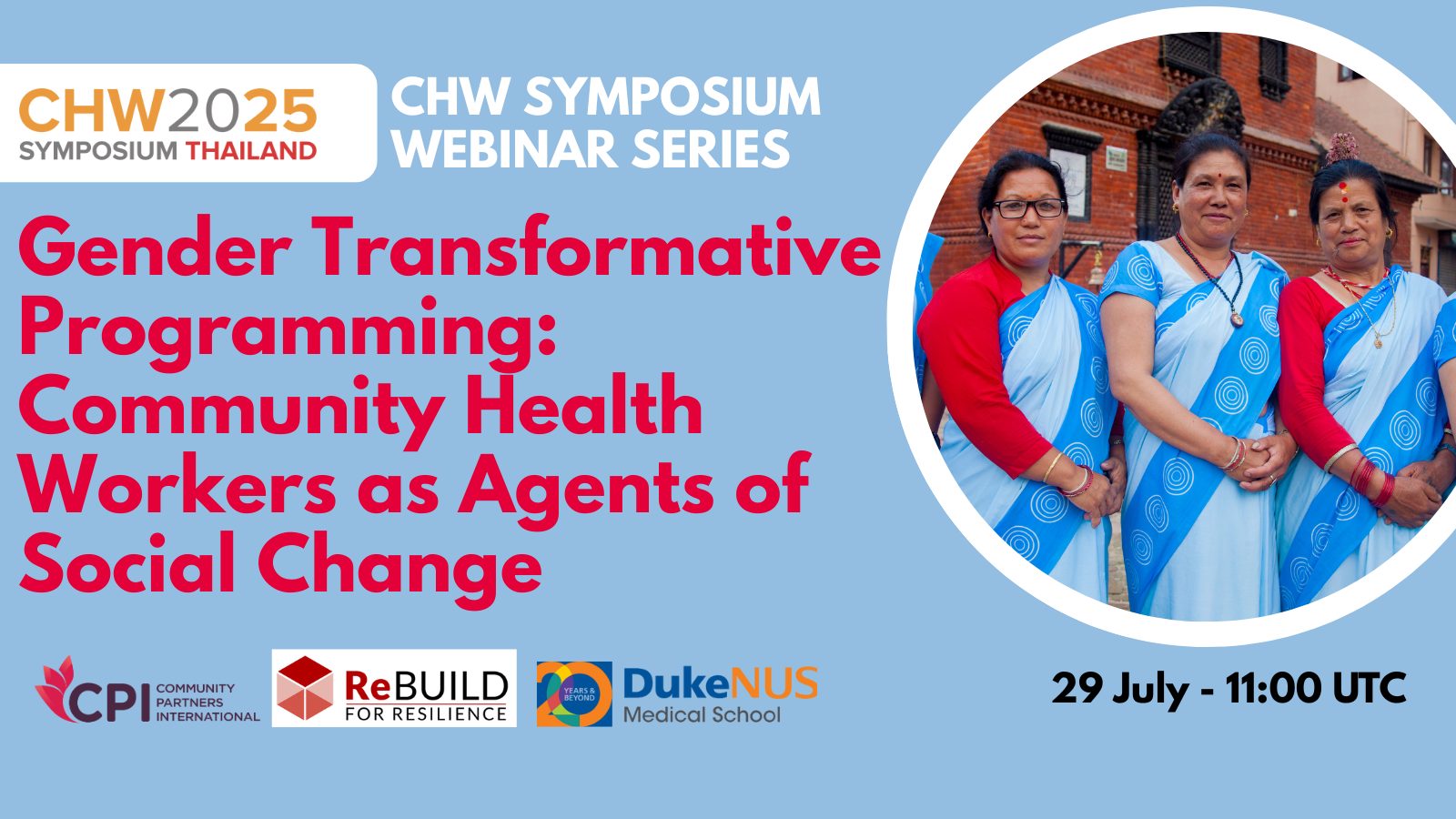
Community Health Worker Symposium webinar series
17 July 2025
This webinar has taken place. Watch the recording here.
November will see the Community Health Workers Symposium 2025 (more on that here – opens new tab). In the run up to the symposium, Community Partners International [opens new tab], in partnership with ReBUILD for Resilience and SingHealth Duke-NUS Global Health Institute, is presenting a webinar series about community health workers. There are five webinars in the series with topics including gender, conflict, research, climate change and sustainable financing. ReBUILD is leading on the first two of this list and we start with gender.
Gender Transformative Programming: Community Health Workers as Agents of Social Change
Speakers [all open in new tabs]
- Professor Sabina Rashid from JPG School of Public Health at BRAC University will speak on the Bangladesh context. She’ll give a brief overview of the impact of gender norms on the mental wellbeing of health workers before exploring how certain strategies, including the BKASH digital payments system, have been used to attempt to alleviate pressures on health workers.
- Abriti Arjyal of HERD International, Nepal will present a short film produced by female community health volunteers in Nepal. She will explain how the film not only depicts the everyday challenges the women face, but how it has helped alter community perspectives around their roles and had an empowering effect for all the women involved in its production.
- Dr Wesam Mansour from Liverpool School of Tropical Medicine and ReBUILD for Resilience will speak on a study which explored the gendered aspects of health workers’ experiences in Myanmar, Sierra Leone, Lebanon and Nepal, drawing lessons on how health workers in fragile contexts might be supported in periods of shock or stress.
- Prossie Muyingo, a community health worker from Mityana district, Uganda. She was recognised as one of the 12 Heroines of Health at 2023 Women in Global Health’s event for her exceptional contributions to public health. Since 2019, she has delivered vital reproductive, maternal, and child health services to 186 households and played a key role during the COVID-19 pandemic by providing life-saving information and support.
- Professor Joanna Raven from Liverpool School of Tropical Medicine and ReBUILD for Resilience will moderate the session.
- The session will begin with a welcome from Siyapah Surathumrong of Community Partners International who will introduce the webinar series.
Background
The global health workforce is deeply gendered, with women comprising the majority of community health workers (CHWs) worldwide. While CHWs often serve as trusted figures within their communities, they do so within systems that mirror and sometimes exacerbate broader gender-based inequalities. This is particularly evident in the informal nature of CHW work, where women frequently face low or no pay, limited job security, and minimal opportunities for career progression.
Despite their critical contributions, CHWs are too often expected to shoulder the burden of advancing gender equity in health systems without sufficient support, recognition, or protection. Gender transformative programming must therefore begin by addressing the structural inequities faced by CHWs themselves. It must centre their safety, agency, and professional development, while also recognising the potential of their everyday work to challenge harmful norms and promote inclusion.
This webinar will explore how gender transformative approaches can reframe and redesign the role of CHWs, not as default gender equity interventions, but as skilled professionals who deserve meaningful investment, voice, and visibility. Drawing on field-based experiences, community-led models, and emerging research, the session will spotlight strategies for strengthening CHW systems in ways that are inclusive, empowering, and truly transformative.
Further information
There’s more information on the webinar series on the CHW Symposium website [opens new tab]
Lots more on ReBUILD’s work with community health workers here.