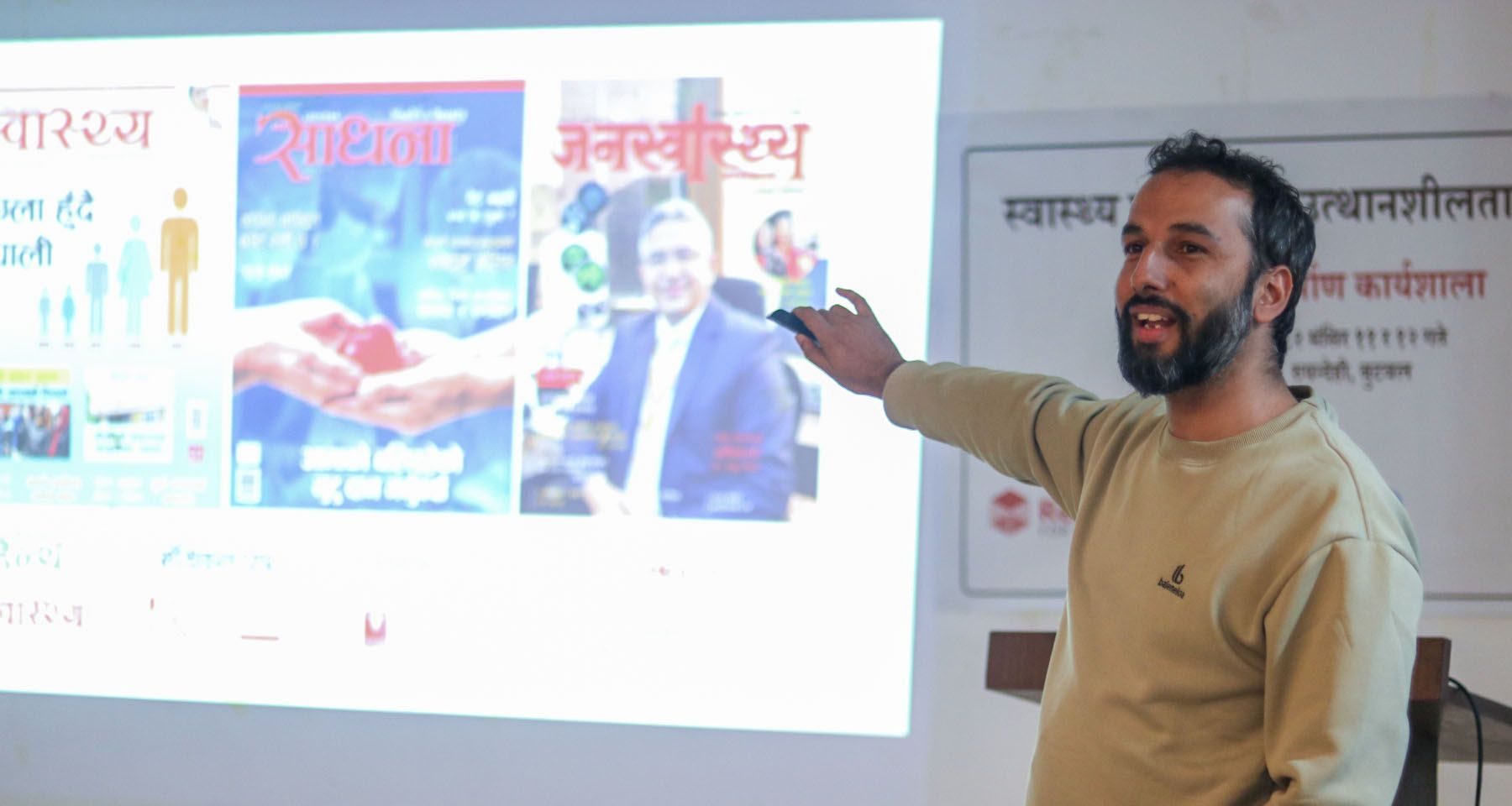
Strengthening the role of the media for health system resilience
Context
Media plays a critical role in shaping public understanding, influencing social norms, and informing policy agendas and decision-making [1], [2]. In the health sector, responsible and evidence-based journalism can support accountability, amplify community voices, and highlight barriers that affect service delivery and equity [3]. [4]. In Nepal, despite the growth of news media outlets, health agendas require more space [5]. Evidence suggests that health reporting is often challenged by inadequate editorial priority, insufficient understanding of health system issues among journalists, and lack of access to credible news sources such as facts, evidence, and expert informants [5], [1].
Activities and approaches
Realising the need to help journalists better understand the health system, health system resilience, and ways to improve health reporting, HERD International worked collaboratively with journalists in the co-creation of a health reporting manual and capacity strengthening on health reporting.
1. Training manual development
The manual was drafted after multiple rounds of consultations with journalists, including reporters and editors, in Lumbini Province. The major topics covered by the manual were health system concepts (including service delivery), governance, financing, equity, and resilience and professional journalistic practices, such as issue identification, evidence use, ethical reporting, and source verification.
This participatory process ensured that the content reflected journalists’ reporting realities and local health system contexts. It also encouraged the journalists to own the manual and use it optimally. Twelve journalists from seven districts of Lumbini province – Parasi, Rupandehi, Kapilvastu, Dang, Banke, Bardiya, and Gulmi – representing radio, print, online, and television media, participated in the workshop. The participants included five women and seven men. The feedback from all participants was documented, the draft was amended accordingly, and the manual was finalised after review by experts. The manual is an important resource for health journalists’ capacity strengthening, whether by facilitators or in relation to self-initiated learning. It also helps journalists engaged in non-health reporting beats to adopt a multisectoral perspective in reporting practices.
2. Orientation on health system reporting
The two-day workshop also included dedicated sessions on reporting health system issues. Training was facilitated by professional resource people – an experienced editor from the national media, a senior health journalist, a journalism expert and a health system expert. The sessions focused on health systems, health system resilience, use of appropriate sources of information, and ethical journalistic practices. Through interactive discussions, case studies, and practical exercises, journalists were oriented on identifying health system issues and were encouraged to practice analytical storytelling, highlighting systemic challenges, accountability, and equity without limiting themselves to routine assignments.
3. Mentoring on issue identification and story development
To translate learning into practice, the journalists pitched story ideas to their respective media outlets. Five journalists who demonstrated continuous commitment and interest in in-depth health reporting were provided with mentorship support. The mentorship included continuous support in different phases of story publication, such as identification of issues, development of story outline, exploration of evidence, fact and other sources of information required for the story, interpretation of evidence, angling of news and overall presentation of news. This iterative process helped enhance the quality of news without affecting editorial independence.
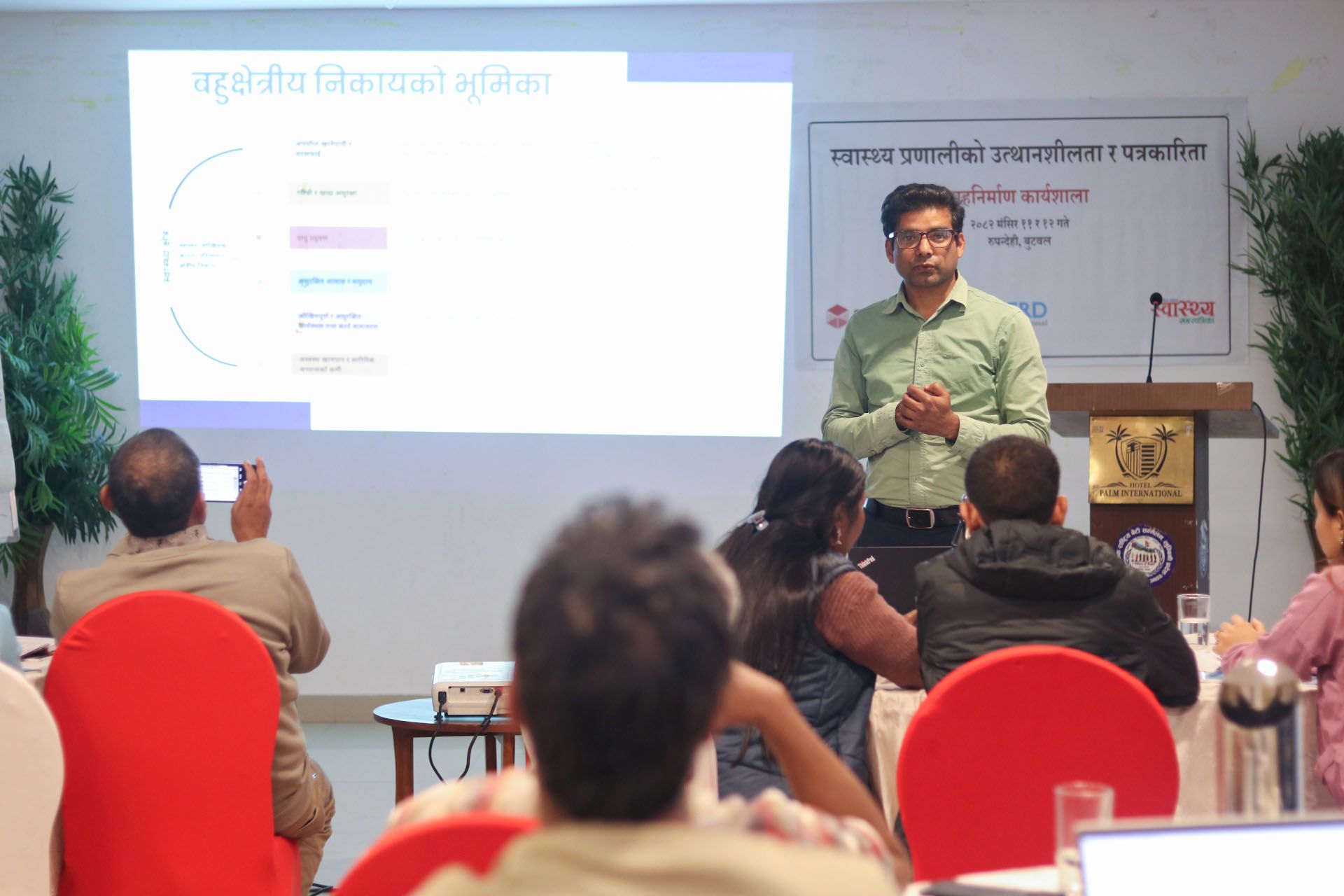
Shreeman Sharma of HERD International represents to journalists in a workshop
Outcomes: Application of a system lens in reporting
Following the mentorship process, five in-depth news stories were produced and published in different media outlets. The stories profiled critical health system challenges from different districts of Lumbini Province, focusing on issues such as access, equity, governance, and service delivery. The reports highlighted the underutilisation of basic health service centres, overcrowding in the hospitals, administrative barriers to services (e.g. a lack of citizenship and birth certificates), delay-plagued health infrastructure, the plight of the Tharu community due to the rising burden of sickle cell anaemia, and problems associated with maternal health service utilisation. Along with raising key health system challenges, these stories stressed that infrastructure expansion alone is not sufficient, but issues such as public trust in primary care, coordination between the three tiers of government, and availability of quality services are equally important for a resilient health system.
These reports used evidence, expert perspectives, and community voices to present health system gaps. Journalists engaged with multiple sources, including health officials, medical experts, community members, and institutional data, to provide balanced and analytical coverage. The mentorship approach helped strengthen evidence-based, accountable and equity-oriented health journalism while drawing public and policy attention to critical gaps in the health system.
Journalists reflected that the co-creation of the manual, orientation sessions, and mentorship strengthened their understanding of health systems and increased their interest in reporting health issues. The engagement activities encouraged them to move beyond event-based reporting and adopt a systems perspective. Journalists shared:
“While working on the story, I realised that many health problems are linked to governance, awareness, and access, not just hospitals or health services. I also realised that there are many issues we should explore besides covering the events.”
“We write on multiple issues with more focus on politics, development and current affairs, so priority on health news reporting is inadequate. This engagement has sensitised me to prioritised health systems issues in reporting.”
Participants expressed interest in continuing to report on health system issues and emphasised that access to reliable data, expert sources, and continued collaboration with researchers will be instrumental for continuing evidence-based and analytical health journalism in the days to come.
Key reflections of journalists
- Prioritising health reporting: Journalists expressed increased interest in giving priority to health issues in their routine reporting.
- Applying a systems lens: They felt encouraged to move beyond event-based coverage and explore in-depth, evidence-based and analytical issues applying a systems lens.
- Strengthening collaboration: Journalists recognised the value of meaningfully engaging with researchers and health system actors to access credible evidence and produce impactful stories.
References
- Barry, A. M., Jarlenski, M., Grob, R., Schlesinger, M., & Gollust, S. E. (2010). News media framing of childhood obesity in the United States from 2000 to 2009. BMC Public Health, 10(1), 535. https://doi.org/10.1186/1471-2458-10-535
- Happer, C., & Philo, G. (2019). The role of the media in the construction of public belief and social change. Critical Public Health, 29(3), 321–333. https://doi.org/10.1080/09581596.2019.1575949
- Khan, M. A., & Afsana, K. (2018). Role of mass media in health care development: A review article. Journal of Advanced Research in Journalism and Mass Communication, 5(1–2), 1–7. Retrieved from https://adrjournalshouse.com/index.php/Journalism-MassComm/article/view/649
- Wijesundara, C. S. (2020). Medical journalism: Its impact and challenges. University of Colombo Review, 1(1). https://doi.org/10.4038/ucr.v1i1.27
- Acharya, B., Khanal, V., & Ghimire, M. (2021). Health reporting characteristics among journalists in Nepal. International Journal of Environmental Research and Public Health, 18(5), 2784. https://doi.org/10.3390/ijerph18052784