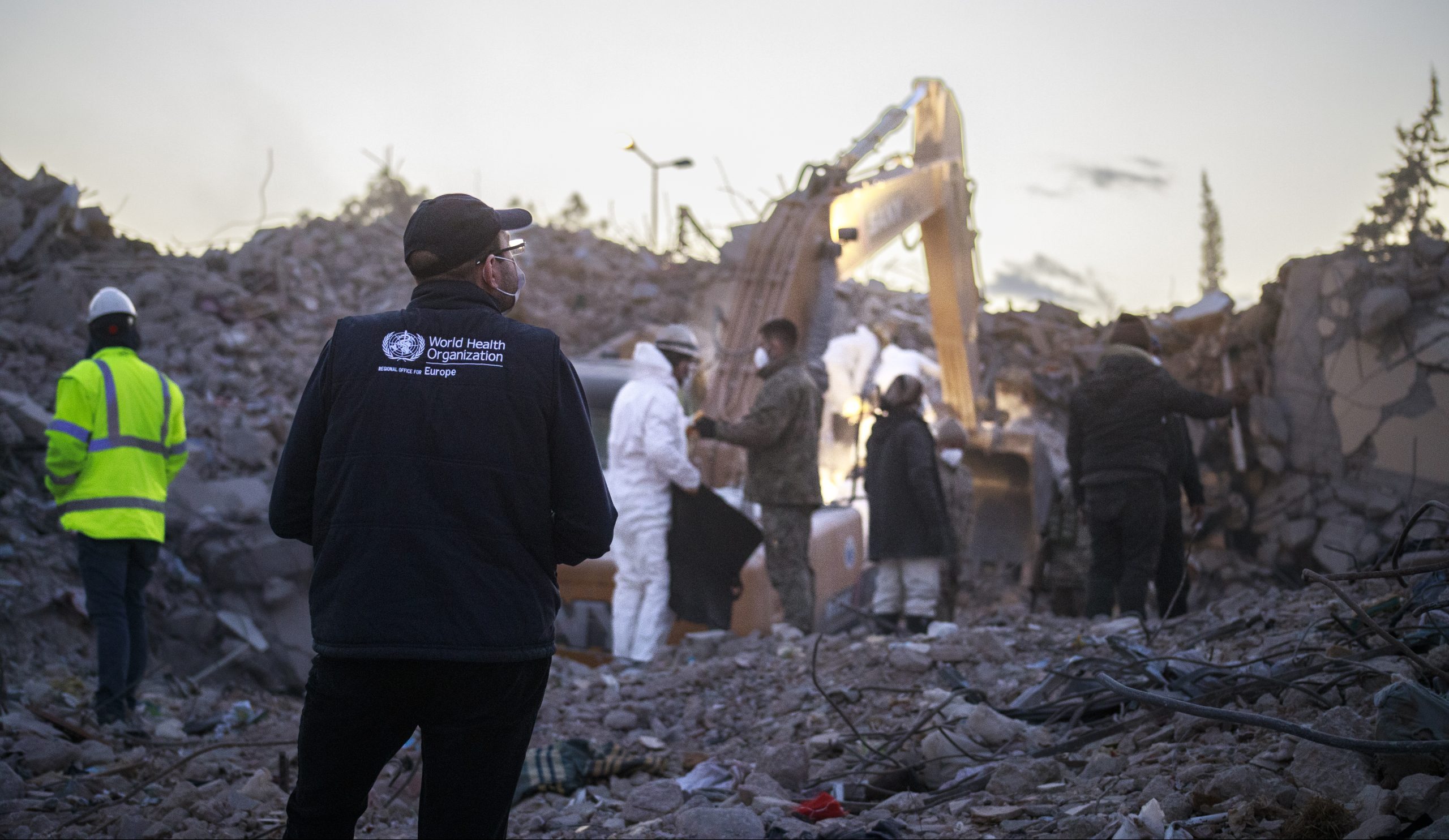
Teams from WHO, who are deployed in the provinces highly affected by the earthquake, collect data for a rapid field assessment. ©WHO / Tunc Ozceber
When first responders are also the victims: How Türkiye’s health workers fared after the earthquake
5 June 2025
In February 2023, Türkiye and Syria were rocked by an earthquake that devastated the densely populated eastern Marmara Sea region with widespread destruction across more than 11 provinces, killing thousands of people. The 7.8 magnitude earthquake was followed by several aftershocks and a second earthquake of 7.6 magnitude. These earthquakes were the deadliest to hit Türkiye since 1999. In this article, Wesam Mansour, Kate Hawkins, Joanna Raven and Dilek Dede reflect on the emergency response and the effects of the disaster on health workers.
This article is based on the study Exploring health workforce preparedness for shocks in Turkey.
Pre-planning
When disaster hit, Türkiye was able to draw on comprehensive plans, informed by past crises, including the COVID-19 pandemic, previous earthquakes and the large-scale Syrian refugee crisis. Centralised authorities played a pivotal role in disaster response through AFAD (the Disaster and Emergency Management Authority), supported by UMKE (National Medical Rescue Teams). They had a relatively strong disaster management system and a well-prepared medical infrastructure, underscoring the effectiveness of pre-existing training, resource allocation, and structural planning in enabling the rapid mobilisation of health workers. However, the scale of the earthquake was beyond their expectation, overwhelming local health facilities and staff, particularly in the early days.
Effects on the health workforce
Even before the earthquake struck Türkiye had health worker shortages, impacting the ability of the health workforce to respond. The total number of health workers had declined to 1.5 million in 2020, a decrease of 243,000 employees (or 1.63%) on the previous year. Infrastructure damage and personal losses meant healthcare staff were both victims of and responders to the earthquake. Many lost family members or experienced displacement. They had to juggle their professional duties while also coping with personal losses. Inevitably, the impact of the shock and health workers’ roles in the response triggered significant psychological harm and trauma.
Damage was borne by 15 hospitals and many other health clinics in the affected areas, resulting in a shortage of medical facilities for injured and displaced populations making workers’ jobs even harder. Those health workers who were able to respond were not necessarily located near the affected areas as Türkiye is a very large country. As a result, they were unable to immediately support their colleagues and the broader relief effort. This geographical mismatch further complicated the already overstretched emergency response.
The response
The health worker response was both commendable and courageous. Healthcare workers often worked beyond standard shift hours to meet the overwhelming demand for health care and ensure that services continued despite exhaustion and resource constraints. To help manage this pressure, operational adjustments were introduced. For example, the adoption of a structured shift system for volunteer doctors better balanced workloads and prevented burnout and helped teams sustain their efforts over time.
More than 10,000 volunteers contributed to UMKE. These included professionals such as doctors, nurses, pharmacists, and laboratory technicians. In addition to these, the Turkish Red Crescent swiftly mobilised another large volunteer workforce of 75,000 to assist with emergency relief activities, including healthcare, logistics, food distribution, and psychosocial support. Volunteer efforts were rapidly coordinated across multiple sectors, playing a key role in setting up temporary shelters, distributing supplies, and organising aid logistics, and ensuring an effective and timely disaster response. Complementing these national efforts, the World Health Organization (WHO) initiated the largest deployment of Emergency Medical Teams (EMTs) to a disaster zone in its 75-year history. These EMTs were composed of international medical personnel and support staff, deployed from several countries to assist Türkiye. The teams were integrated into the health response, providing critical emergency care, conducting surgeries and ensuring access to primary care services, where local capacity was overwhelmed. Their presence supported immediate medical needs and helped stabilise the health system during the acute response phase.
To address urgent staffing gaps following the earthquake, many health organisations implemented emergency recruitment policies, significantly reducing the time it typically takes to hire health workers. Instead of standard multi-step processes involving screening, technical tests, and panel interviews, these policies introduced a simplified hiring procedure which prioritised efficiency over bureaucracy and ensured critical personnel were recruited without unnecessary delays. Organisations also relied on support from regional offices and professional associations to quickly identify and place qualified candidates, ensuring continuity of services. This fast-track recruitment played a significant role in sustaining essential services during overwhelming demand for healthcare workers and emergency responders.
Specialised staff were targeted for deployment to ensure that critical medical services, such as dialysis and surgery, continued despite the chaotic environment. For example, kidney function deterioration is common among trauma patients due to dehydration, sepsis and crush injuries, making dialysis services critical. By identifying and dispatching dialysis nurses to areas where they were most needed, response teams ensured that patients requiring immediate renal support received timely care. Senior healthcare managers from unaffected regions were strategically deployed to oversee health operations in disaster zones, ensuring administrative continuity despite the crisis.
Human resources policies were adapted to provide flexibility and support to staff facing personal challenges due to the disaster. For example, the performance management and attendance policy were temporarily suspended to provide more flexibility. An additional four vacation days were provided to staff so that they could take care of themselves and their families. Health insurance coverage, hardship allowances and other financial compensation policies were introduced to assist affected employees, particularly those who had suffered housing loss or the death of close family members. This ensured that those working in the hardest-hit regions received financial compensation for their additional challenges, helping retain staff and sustain morale.
Peer support and structured mental health training programmes were introduced to maintain wellbeing of health workers. These involved training for staff to support each other through peer groups, hundreds of face-to-face psychological support sessions covering thousands of employees, and a long-term commitment to mental health. Additionally, targeted materials were developed specifically for healthcare workers dealing with disaster trauma. The WHO and NGOs were instrumental in coordinating mental health support for health workers.
Challenges faced and lessons for the future
One of the main challenges during the response was the central management of the huge number of volunteers who flooded into the disaster areas. This sometimes meant that higher level policy guidance was not effectively translated into local policies, leading to inconsistencies. For example, volunteers were often required to use their personal leave to participate in emergency efforts, which imposed an unfair financial and professional burden upon them. They also had to immediately resume their professional duties after physically and emotionally demanding assignments, without any transition period for recovery.
The earthquake showed how resilient the health workforce in Türkiye is. However, it also exposed significant gaps in emergency preparedness, equity, and coordination. To improve future responses, emergency preparedness must be more localised, inclusive, and adequately resourced. More preparation within the local health system is needed. This should include training healthcare workers specifically for emergency events to enhance their ability to manage crisis situations, minimise delays in healthcare and ensure that teams function efficiently under extreme conditions. A structured preparedness programme should include simulation drills, disaster response workshops, and experience-sharing sessions to improve competency in high-pressure environments. Addressing these issues will help manage future crises and ensure a more responsive, resilient, and equitable health system.
This blog draws on a broader study about the health system’s emergency response after the earthquake. Further insights and recommendations will be published over the coming months. To find out more, or if you have any questions, please contact Wesam Mansour.
Further information
More on this study and its other outputs here: Exploring health workforce preparedness for shocks in Turkey.
Image: 15 February 2023, Türkiye-Syria earthquake. Teams from WHO are deployed in the Turkish provinces affected by the earthquake and collect data for the ongoing rapid field assessment. © WHO / Tunc Ozceber [opens new tab]